Evidence for Jesus
My Personal Takeaways →Evidence for Jesus: Timeless Answers for Tough Questions about Christ
By Josh McDowell and Sean McDowell
INTRODUCTION
- What we conclude about the identity of Jesus is the most important decision we will ever make. This is why Jesus asked, “Who do you say that I am?” (Mark 8:29). Our answer to this question has implications for how we live our lives and for our eternal destinies.
SECTION 1: THE HISTORICAL EVIDENCE FOR JESUS
- The vast majority of scholars today—across a wide range of perspectives and disciplines—collectively believe Jesus was at least a historical figure who lived and died in the first century AD. Even the agnostic New Testament scholar Bart Ehrman has written a book defending the existence of Jesus: Did Jesus Exist? The Historical Argument for Jesus of Nazareth.
CHAPTER 1: CAN WE USE THE BIBLE FOR HISTORICAL EVIDENCE OF JESUS?
-
One of the most common challenges to the reliability of the New Testament is that the documents are unreliable because they are biased.
-
Accusations of bias can cut both ways. Consider the example of Holocaust survivors. Such individuals would undoubtedly be biased. But this does not in itself provide good reason to discount their testimony.
-
Agnostic New Testament scholar Bart Ehrman is skeptical about the supernatural accounts surrounding Jesus’s life. But this does not lead him to deny the existence of Jesus. After examining the Gospels, as well as the traditions from which they arose, Ehrman concluded, “The vast network of these traditions, numerically significant, widely dispersed, and largely independent of one another, makes it almost certain that whatever one wants to say about Jesus, at the very least one must say that he existed.”
-
Paul clearly based many arguments on the assumption that Jesus did exist. His writings are important because they are likely the earliest Christian documents and the earliest writings we have concerning Jesus as a historical person. Even critical scholars accept that Paul wrote seven of the letters attributed to him (Galatians, 1 Corinthians, 2 Corinthians, Romans, Philemon, Philippians, and 1 Thessalonians).
-
Paul knew that Jesus…
- …was born and raised as a Jew (Galatians 4:4)
- …was a descendant of Abraham and David (Romans 1:3; Galatians 3:16)
- …had a brother named James (Galatians 1:19)
- …possibly had other brothers as well (1 Corinthians 9:5)
- …had numerous disciples (1 Corinthians 9:5)
- …was betrayed (1 Corinthians 11:23) and executed by crucifixion (1 Corinthians 1:17–18; Galatians 5:11; 6:12; Philemon 2:8; 3:18) with the help of some Judean Jews (1 Thessalonians 2:14–15)
- …instituted the Lord’s Supper the night before his death (1 Corinthians 11:23–25)
- …was buried and resurrected three days later (Romans 4:24–25; 1 Corinthians 15:4–8; 2 Corinthians 4:14; Galatians 1:1; 1 Thessalonians 4:14)
- …was meek, gentle, self-sacrificial, and humble (2 Corinthians 10:1; Philemon 2:5–7)
- …lived a model life that should be imitated by all (1 Corinthians 11:1).
CHAPTER 2: IS THERE EVIDENCE FOR JESUS OUTSIDE THE BIBLE?
-
Let’s look at the two most important ancient non-Christian sources for evidence of the historical Jesus: Cornelius Tacitus and Flavius Josephus.
-
Cornelius Tacitus was a Roman historian who lived approximately AD 56 to 120. Many scholars consider him the greatest Roman historian and see the Annals as our best source of information for the time surrounding the life of Jesus.
-
In AD 64 there was a devastating fire for which many people believed Nero was responsible. To stop the public outcry, Nero blamed the Christians. Tacitus explains what happened: ”Consequently, to get rid of the report, Nero fastened the guilt and inflicted the most exquisite tortures on a class hated for their abominations, called Christians by the populace. Christus, from whom the name had its origin, suffered the extreme penalty during the reign of Tiberius at the hands of one of our procurators, Pontius Pilatus, and a most mischievous superstition, thus checked for the moment, again broke out not only in Judaea, the first source of the evil, but even in Rome, where all things hideous and shameful from every part of the world find their centre and become popular.”
-
Could Tacitus’s text be a forgery? Or, at the very least, could Christians have snuck in information locating Jesus as a historical person? This is highly unlikely for three reasons: 1. Tacitus clearly despises Christians. If a Christian altered the document, he probably wouldn’t have been so offensive toward Christians. 2. The passage doesn’t specifically mention the resurrection, something a Christian editor would have been eager to include. 3. The style of the text is seamless, meaning there doesn’t seem to be any evidence of someone editing the text.
-
While we don’t know the source Tacitus relied on for his information about Jesus, we do know he considered it reliable enough to include in his writings. Thus, it should be part of our larger case for the existence of Jesus.
-
Flavius Josephus was a Jewish politician, soldier, and historian who lived around AD 37 to 100. He’s considered the most important Jewish historian of ancient times. Josephus wrote Antiquities of the Jews to explain the Jewish people and their beliefs to Romans to reduce anti-Jewish bigotry. Two passages in Antiquities are important in our investigation of the historicity of Jesus.
-
In Antiquities, Josephus writes about the death of Jesus’s brother James at the instigation of the high priest Ananus.
-
“He assembled the Sanhedrin of judges, and brought before them the brother of Jesus, who was called Christ, whose name was James, and some others… . He delivered them to be stoned.”
-
There are other non-Christian sources of information about Jesus of Nazareth, such as Suetonius, Celsus, and Thallus, but Tacitus and Josephus alone suffice to establish Jesus’s historicity.
CHAPTER 3: ARE THERE CHRISTIAN SOURCES FOR JESUS OUTSIDE THE BIBLE?
-
First Clement is a letter written to the church at Corinth in the late first or early second century from the church at Rome. It is widely believed Clement knew the apostles, including Peter and Paul, and may even be the man mentioned in Philippians 4:3. First Clement includes a reference to Jesus and the early church: The Apostles received the Gospel for us from the Lord Jesus Christ; Jesus Christ was sent forth from God. So then Christ is from God, and the Apostles are from Christ. Both therefore came of the will of God in the appointed order. Having therefore received a charge, and having been fully assured through the resurrection of our Lord Jesus Christ and confirmed in the word of God with full assurance of the Holy Ghost, they went forth with the glad tidings that the kingdom of God should come. So preaching everywhere in country and town, they appointed their firstfruits, when they had proved them by the Spirit, to be bishops and deacons unto them that should believe.
-
Ignatius was the bishop of Antioch and was condemned to death in Rome in the early second century. There are several historical references to Jesus in letters written by Ignatius, including To the Trallians: Jesus Christ, who was of the race of David, who was the Son of Mary, who was truly born and ate and drank, was truly persecuted under Pontius Pilate, was truly crucified and died in the sight of those in heaven and those on earth and those under the earth; who moreover was truly raised from the dead, His Father having raised Him, who in the like fashion will so raise us also who believe on Him.
-
Ehrman sees Ignatius as a significant witness for the historicity of Jesus: Ignatius, then, provides us yet with another independent witness to the life of Jesus. Again, it should not be objected that he is writing too late to be of any value in our quest. He cannot be shown to have been relying on the Gospels. And he was bishop in Antioch, the city where both Peter and Paul spent considerable time in the preceding generation, as Paul himself tells us in Galatians. His views too can trace a lineage straight back to apostolic times.
-
Polycarp was a student of the apostle John and knew of other apostles, which we learn from his student, Irenaeus: But Polycarp also was not only instructed by apostles, and conversed with many who had seen Christ, but was also, by apostles in Asia, appointed bishop of the Church in Smyrna, whom I also saw in my early youth, for he tarried [on earth] a very long time, and, when a very old man, gloriously and most nobly suffering martyrdom, departed this life, having always taught the things which he had learned from the apostles, and which the Church has handed down, and which alone are true.
-
Papias also provides information that some believe confirms that Matthew and Mark are the true authors of the gospels containing their names: [This also the presbyter said: “Mark, having become the interpreter of Peter, wrote down accurately, though not in order, whatsoever he remembered of the things said or done by Christ. For he neither heard the Lord nor followed him, but afterward, as I said, he followed Peter, who adapted his teaching to the needs of his hearers, but with no intention of giving a connected account of the Lord’s discourses, so that Mark committed no error while he thus wrote some things as he remembered them. For he was careful of one thing, not to omit any of the things which he had heard, and not to state any of them falsely.” These things are related by Papias concerning Mark. But concerning Matthew he writes as follows: “So then Matthew wrote the oracles in the Hebrew language, and every one interpreted them as he was able.” And the same writer uses testimonies from the first Epistle of John and from that of Peter likewise. And he relates another story of a woman, who was accused of many sins before the Lord, which is contained in the Gospel according to the Hebrews. These things we have thought it necessary to observe in addition to what has been already stated.]
CHAPTER 4: IS THE NEW TESTAMENT RELIABLE?
- How will we approach this task? By the same criteria that other historical documents are tested. We will consider three tests: the bibliographical test, the internal evidence test, and the external evidence test.

- Without question, the New Testament boasts the best attested manuscript transmission when compared with other ancient documents. The bibliographical test helps confirm that the New Testament has been accurately transmitted through the centuries. Here’s a table of the number of New Testament manuscripts broken down by language:

-
There is no other work of antiquity that has more and earlier copies than the New Testament. Thus, we are on solid ground to conclude that the text of the New Testament meets the bibliographical test.
-
A common objection to the reliability of the Bible is that it is full of contradictions. While some statements may appear contradictory, many apparent contradictions can be resolved with just a little research. For example, the Gospels and Acts provide conflicting versions of the death of Judas Iscariot. Matthew relates that Judas died by hanging himself. But Acts says that Judas fell headlong into a field, and “he burst open in the middle and all his entrails gushed out” (Acts 1:18). How can both be true? Easy. Judas hung himself, but the branch or the rope broke and his body fell into a field. This explanation is not a desperate attempt at harmonization but is suggested by the text itself. When a living person falls, he does not generally burst open. But if Judas were already dead, and it was his body that fell from some height, this is what we might expect.
-
Luke wants his readers to know they are reading true, reliable accounts. The New Testament writers consistently claim to be reporting reliable testimony to the events they describe (2 Peter 1:16; 1 John 1:3; Acts 2:32; John 19:35).
-
If you were writing a story about your life, would you include embarrassing stories or details that showed you in a negative light? Probably not. But the New Testament includes many things that could be considered embarrassing and even harmful to the leaders of the Christian movement. For example, Jesus’s family, including his brother James, thought he was crazy (Mark 3:21; John 7:5). The disciples are repeatedly portrayed as being doubtful (Matthew 28:17), dim-witted and slow to understand Jesus’s teachings (Mark 8:14–21, 31–33; 9:31–32; 10:35–40), cowards (John 20:19), and even deniers of Jesus (John 18:25–26). Why would the New Testament writers include these details if they weren’t true?
-
As we explored in chapter 2, there are also extrabiblical writings that corroborate key events in Jesus’s life, such as his crucifixion by the Romans and James being his brother. Thus, we can see that the New Testament passes the third and final test for the reliability for historical documents.
SECTION 2: THE IDENTITY OF JESUS
- Jesus is the eternal creator who took on human flesh. No other religious figure has made such an audacious claim. Moses didn’t. Krishna didn’t. Muhammad didn’t. Buddha didn’t. Among all the great religious leaders, Jesus uniquely claimed to be God in human flesh.
CHAPTER 5: DID JESUS CLAIM TO BE GOD?
-
During Jesus’s trial, the high priest asked him, “Are You the Christ, the Son of the Blessed?” Jesus responded, “I am. And you will see the Son of Man sitting at the right hand of the Power, and coming with the clouds of heaven” (Mark 14:62). This infuriated the high priest, and Jesus was condemned to death.
-
But what is significant about the words that follow, about the term “Son of Man”? Jesus was alluding to Daniel’s vision of one “coming with the clouds of heaven” and given an everlasting kingdom over “all peoples, nations, and languages.” On trial for his life, he was addressing Jewish scholars who would recognize his response as an electrifying claim from Daniel 7:13–14.
-
John 10:25, 30–33 Jesus answered … “I and the Father are one.” The Jews picked up stones again to stone him. Jesus answered them, “I have shown you many good works from the Father; for which of them are you going to stone me?” The Jews answered him, “It is not for a good work that we are going to stone you but for blasphemy, because you, being a man, make yourself God.”
-
Jesus answered them, “My Father has been working until now, and I have been working.” Therefore the Jews sought all the more to kill Him, because He not only broke the Sabbath, but also said that God was His Father, making Himself equal with God.
-
John 8:57–59. Then the Jews said to Him, “You are not yet fifty years old, and have You seen Abraham?” Jesus said to them, “Most assuredly, I say to you, before Abraham was, I AM.” Then they took up stones to throw at Him.
-
The phrase “I AM” is broadly understood to refer to the God of the Old Testament and was so understood by Jesus’s Jewish audience. (Their response indicates their instant recognition that such a statement made by a mere man would be blasphemy, deserving death.) For example, in the book of Exodus, God said to Moses, “I AM WHO I AM… . Thus you shall say to the children of Israel, ‘I AM has sent me to you’” (Exodus 3:14).
-
John 5:22–23 “The Father judges no one, but has given all judgment to the Son, that all may honor the Son, just as they honor the Father. Whoever does not honor the Son does not honor the Father who sent him.”
-
John 14:7–9: “If you had known me, you would have known my Father also. From now on you do know him and have seen him.” Philip said to him, “Lord, show us the Father, and it is enough for us.” Jesus said to him, “Have I been with you so long, and you still do not know me, Philip? Whoever has seen me has seen the Father. How can you say, ‘Show us the Father’?”
-
Matthew 11:27 “All things have been handed over to me by my Father, and no one knows the Son except the Father, and no one knows the Father except the Son and anyone to whom the Son chooses to reveal him.”
-
Matthew 5:21–22: You have heard that it was said to those of old … But I say to you …
-
This statement is an excerpt from Jesus’s Sermon on the Mount, where he repeatedly cites the Old Testament law and then asserts his own authority as supreme. This was extraordinary in a Jewish culture that revered the teachings of its prophets and patriarchs as sacred. Instead of repeating the prophets by saying, “Thus saith the Lord,” Jesus elevates the authority of his own words above theirs. On at least six occasions (commonly referred to as the antitheses), he uses the formula, “You have heard that it was said … but I say to you.”
-
Another way that Jesus claimed to be God is by receiving worship.
-
In Matthew 4:10, Jesus himself says, “You shall worship the LORD your God, and Him only you shall serve.”
-
Yet we find that Jesus accepted worship. Note the examples in Matthew 14:33, John 9:38, Matthew 28:9, and Luke 24:52. When one reads the full context of these passages, Jesus never corrects people for worshiping him. In particular, the religious context of Luke 24:52, which occurs after Jesus’s ascension into heaven, clearly indicates that the disciples worshiped him. In contrast to his disciples and angels, Jesus readily accepted worship.
CHAPTER 6: WHAT DID THE FOLLOWERS OF JESUS THINK ABOUT HIS IDENTITY?
-
Think about it: If Jesus was just a nice guy, why torture him to death? Jesus was put to death not for what he did but for who he claimed to be.
-
Before we consider some specific examples of Paul affirming the deity of Jesus, it is important to note that Paul emphasized strongly that he preached the same gospel as the apostles. He portrayed himself as being on the same team as Cephas [Peter] and Apollos (1 Corinthians 1:12–13), and he confirmed that his gospel message was the same as that of the apostles when he visited Jerusalem (Galatians 2:6).
-
Philippians 2:6–11 [Jesus,] who, being in very nature God, did not consider equality with God something to be used to his own advantage; rather, he made himself nothing by taking the very nature of a servant, being made in human likeness. And being found in appearance as a man, he humbled himself by becoming obedient to death— even death on a cross! Therefore God exalted him to the highest place and gave him the name that is above every name, that at the name of Jesus every knee should bow, in heaven and on earth and under the earth, and every tongue acknowledge that Jesus Christ is Lord, to the glory of God the Father.
-
Peter echoes the expression Paul uses in Titus 2:13, calling Jesus “our God and Savior.” This was a common first-century religious expression referring to Yahweh, and so this title affirms that both Paul and Peter believed Jesus was God.
-
John 20:28 Thomas answered and said to Him, “My Lord and my God!”
-
Hebrews 1:3 [Jesus] is the radiance of the glory of God and the exact imprint of his nature, and he upholds the universe by the word of his power.
-
John 1:1, 14 In the beginning was the Word, and the Word was with God, and the Word was God… . And the Word became flesh and dwelt among us, and we beheld His glory, the glory as of the only begotten of the Father, full of grace and truth.
-
1 John 5:20 We know that the Son of God has come and has given us understanding, so that we may know him who is true; and we are in him who is true, in his Son Jesus Christ. He is the true God and eternal life.
-
We have seen that his closest friends and first followers also believed Jesus was God. They refered to him as the Son of God and “God over all,” and they worshiped him as divine. As seen through both their words and actions, the first followers of Jesus truly believed he was God in human flesh. They believed this so deeply, they suffered and died for this belief
CHAPTER 7: IS THERE CIRCUMSTANTIAL EVIDENCE THAT JESUS IS GOD?
-
Mark 2:5–7 says, “When Jesus saw their faith, he said to the paralytic, ‘Son, your sins are forgiven.’ Now some of the scribes were sitting there, questioning in their hearts, ‘Why does this man speak like that? He is blaspheming! Who can forgive sins but God alone?’”
-
“Which is easier, to say to the paralytic, ‘Your sins are forgiven,’ or to say, ‘Rise, take up your bed and walk’? But that you may know that the Son of Man has authority on earth to forgive sins”—he said to the paralytic—“I say to you, rise, pick up your bed, and go home.” And he rose and immediately picked up his bed and went out before them all, so that they were all amazed and glorified God, saying, “We never saw anything like this!” (Mark 2:9–12)
-
The New Testament makes another noteworthy claim: that Jesus existed before his life on earth. At one time he prayed, “And now, O Father, glorify Me together with Yourself, with the glory which I had with You before the world was” (John 17:5). He also taught people, “I have come down from heaven, not to do My own will, but the will of Him who sent Me” (John 6:38). Many similar statements are found throughout the Gospels and in the New Testament Epistles (for example, Philemon 2:6-11; Romans 8:3; 1 John 1:2; and Galatians 4:4).
-
The New Testament authors ascribed to Jesus many of the titles used for God in the Old Testament, thus showing that they believed Jesus was the very same God of the Old Testament.

- Jesus forgave sins and accepted worship. He claimed a special relationship with the Father and referred to himself using titles explicitly reserved for God.
CHAPTER 8: WAS JESUS MERELY A PROPHET OR A GOOD PERSON?
-
A man who was merely a man and said the sort of things Jesus said would not be a great moral teacher. He would either be a lunatic—on a level with the man who says he is a poached egg—or else he would be the Devil of Hell. You must make your choice. Either this man was, and is, the Son of God: or else a madman or something worse. You can shut Him up for a fool, you can spit at Him and kill Him as a demon; or you can fall at His feet and call Him Lord and God. But let us not come with any patronising nonsense about His being a great human teacher. He has not left that open to us. He did not intend to.
-
Jesus asked his disciples, “Who do you say that I am?” to which Peter responded, “You are the Christ, the Son of the living God” (Matthew 16:15–16).
-
If Jesus had been lying, he would also have been a fool because his claims to deity led to his crucifixion.
-
Financial greed. Jesus is never described as a man who possessed financial wealth. He taught his disciples to give their possessions to the needy and not to store up treasure in this life but to store up spiritual treasure in the life to come (Luke 12:32–34). He told the rich young ruler, “If you want to be perfect, go, sell what you have and give to the poor, and you will have treasure in heaven; and come, follow Me” (Matthew 19:21). Jesus gained nothing financially from his preaching, teaching, or healing ministry.
-
Sexual or relational desire. No evidence suggests that Jesus was motivated by lust or relationships. Many women followed Jesus (Luke 8:1–3), many of them coming from vulnerable situations. He could have taken advantage of them, as other men in positions of power have done. But by all accounts, Jesus showed women the highest respect, even in ways that were countercultural at the time (see Luke 8:42–48; John 4:1–45).
-
The pursuit of power. It is utterly unreasonable to assert that Jesus lied about his identity to gain power. Rather than gaining power for himself, he modeled serving others (John 13:1–16; 15:13) and giving without expectation of return, even to the wicked and ungrateful (Luke 6:35–36), and he taught his disciples to do the same. In a dispute over who would be greatest in the kingdom, Jesus taught his disciples that the greatest is the one who serves (Luke 22:24–27).
-
Reading the Gospels, we see a man of great wisdom, compassion, and wonder. Jesus constantly outwitted the religious leaders when they sought to entrap him. He loved and served even the most marginalized and unloved people of his time. Jesus constantly amazed people with his teachings and authority. He also had incredible insight into the human mind and heart. There is no reason to believe Jesus was crazy. Jesus was no lunatic. In light of what we know about Jesus and his impact, it is difficult to conclude that he was mentally disturbed. He spoke some of the most profound words ever spoken. He told some of the most memorable stories ever told. His instructions have liberated countless people in mental bondage.
SECTION 3: WHY JESUS IS UNIQUE
CHAPTER 9: WHAT IS UNIQUE ABOUT JESUS’S LIFE AND TEACHINGS?
-
Jesus had a unique entrance into human history. The Gospels tell us that Jesus had no earthly father but was conceived of the Holy Spirit (Matthew 1:20, 22–23; Luke 1:35).
-
While many religious leaders and their followers have been martyred for their beliefs, Jesus is the only religious figure who is reported to have risen from the dead.
-
While there have been many other prophets within Christianity, it was founded by Jesus of Nazareth, who uniquely claimed to be God in the flesh. Jesus did not simply point the way to God, as other prophets do; he said he is the way (John 14:6).
-
Many other religious figures, such as Joseph Smith (the founder of the Church of Jesus Christ of Latter-day Saints), were viewed as prophets, or even allegedly had aspects of their lives prophesied by the prophets who preceded them. Yet the degree to which Jesus’s birth, ministry, and death were foretold hundreds of years before his coming is unparalleled.
-
The consistent testimony of first-century Christians to the character of Jesus was that he was without sin, perfect in holiness and righteousness. There are no dissenting statements from Christians in the first century (or in the second century, for that matter).
-
The gospel of John records a hostile encounter between Jesus and the Pharisees in which the religious leaders questioned Jesus’s authority and ability to testify on behalf of the Father. At one point, Jesus laid down the challenge, “Can any of you prove me guilty of sin?” (John 8:46). They couldn’t. This shows that even Jesus’s enemies knew he was a uniquely moral man, one of impeccable character.
-
While Jesus is obviously the central figure of Christianity, did you know he is featured prominently in many other world religions as well?
- Islam: Islam acknowledges many facts about Jesus, or “Isa,” such as being born of a virgin and being a wise teacher, a prophet, and a miracle worker.
-
No one has had a greater impact on human history than Jesus. In his book Person of Interest, J. Warner Wallace discusses the incredible ways the world seemed to be preparing for the coming of Jesus, as well as how Jesus forever altered the course of history. Jesus arrived at a remarkable time for his message to be spread. Rome controlled much of the territory surrounding the Middle East, such as southern Europe, northern Africa, and the Mediterranean region. A common language and a great transportation system were in place so people could easily share the good news throughout their known world. Jesus also lived within the time of the Pax Romana, or Roman peace, in which Jews could peacefully and reasonably live in Roman cities and retain much of their custom and culture. There was also a greater degree of religious tolerance than ever before, so Jews could teach and worship. Accordingly, it seems that the scene was perfectly set for Jesus to arrive and his message to be spread. Moreover, Wallace argues that Jesus had an unrivaled impact on the world apart from his religious teaching. No other person in history has been the subject of or inspiration for (explicitly or implicitly) more music, movies, and artwork across all styles and genres than Jesus.
-
To be clear, this doesn’t prove that Jesus is God. But it fits with what we might expect if God were to enter history as a human being. These considerations should drive us to deeply consider the identity of such a remarkable figure.
-
Jesus is unique—unlike any other religious figure—in his birth, death and resurrection, claim to deity, fulfillment of prophecy, and sinless life. He is also featured prominently in many belief systems besides Christianity. No other person has had a greater impact on human history.
CHAPTER 10: WHAT IS UNIQUE ABOUT JESUS’S MIRACLES?
-
Removing the miracles from Christianity is not an option. As C. S. Lewis put it, “All the essentials of Hinduism would, I think, remain unimpaired if you subtracted the miraculous, and the same is almost true of Mohammedanism. But you cannot do that with Christianity. It is precisely the story of a great Miracle. A naturalistic Christianity leaves out all that is specifically Christian.”
-
“There is a general consensus among scholars of early Christianity that Jesus was a miracle worker… . Most scholars today working on the subject thus accept the claim that Jesus was a healer and exorcist.”
-
Ancient Jewish opponents of Jesus and of early Christianity didn’t deny that Jesus had performed miracles; instead, when they offered any opinion about them, they characterized them as sorcery or as the work of the devil. We can see this in the gospels themselves, where the scribes are reported as offering this explanation: “The scribes who came down from Jerusalem were saying, ‘He is possessed by Beelzebul,’ and ‘by the prince of demons he casts out the demons’” (Mark 3:22; see also Matthew 9:34; 10:25; 12:24; Luke 11:15).
-
Toward the end of the first century, the Jewish historian Josephus described Jesus as “a worker of amazing deeds.”
-
Miraculous or supernatural acts have been reported throughout history, but with rare exceptions these miracles appear to have been isolated incidents. In this sense, supernatural events likely did occur in the first century apart from the direct involvement of Jesus Christ. What made Jesus unique was his well-deserved reputation as a successful miracle worker.
-
Jesus never performed miracles to show off; he did not seek to gain anything for himself. His miracles were intimately bound up with his message that the kingdom of God was at hand and that it had arrived in his own person. When he began his ministry, his message was summed up by the announcement of the kingdom: “The time is fulfilled, and the kingdom of God is at hand. Repent, and believe in the gospel” (Mark 1:15).
-
“And he went throughout all Galilee, teaching in their synagogues and proclaiming the gospel of the kingdom and healing every disease and every affliction among the people” (Matthew 4:23; see also 9:35). The best explanation for the unique way Jesus performed miracles is that he understood them to be expressions of the power of God in him (Luke 5:17).
CHAPTER 11: IS JESUS REALLY THE ONLY WAY?
-
The clearest example of Jesus claiming to be the only way to God is in John 14:6: “I am the way, the truth, and the life. No one comes to the Father except through Me.”
-
Several chapters earlier in John’s gospel, Jesus was challenged by a group of Jewish leaders who denied that he was the Messiah. Jesus told them, “If you do not believe that I am He, you will die in your sins” (John 8:24). Luke 10:16 records Jesus telling his followers something similar: “Whoever rejects me rejects him who sent me.”
-
In John 14, Jesus uses pastoral imagery to help the disciples understand his mission. The sheep are a symbol for God’s people, and the sheep pen is a symbol for the kingdom of God. Jesus states that he is the shepherd who guides, protects, and lays down his life for the sheep. But he also says he is the gate by which the sheep may enter the pen. Just as no one can come to the Father except through Jesus (John 14:6), no one can enter the “sheep pen” except through the “gate,” which is Jesus. He concludes with the audacious statement, “I and My Father are one” (John 10:30), another implicit claim that he is the only way to the Father.
-
Jesus uses gate imagery to describe the exclusive nature of Christianity. He said the “road that leads to destruction” is wide, while the gate is small and the “road that leads to life” is narrow “and only a few find it” (Matthew 7:13–14). Several chapters later Jesus says that the Father has given him authority because of their unique relationship: “No one knows the Son except the Father, and no one knows the Father except the Son and anyone to whom the Son chooses to reveal him” (Matthew 11:27).
-
When Peter and John were brought before the Sanhedrin, Peter boldly proclaimed the gospel of Jesus Christ, that “salvation is found in no one else, for there is no other name under heaven given to mankind by which we must be saved” (Acts 4:12). It doesn’t get much clearer than that.
-
Paul and Silas had been jailed for preaching the gospel, and God sent a powerful earthquake to loosen all the prisoners’ chains and open the prison doors. When the jailer realized what had happened and that none of the prisoners had tried to escape, he asked Paul and Silas what he must do to be saved. They replied, “Believe in the Lord Jesus” (Acts 16:31).
-
Paul also tells us in 1 Timothy 2:5 that “there is one God and one mediator between God and mankind, the man Christ Jesus,” reiterating that Jesus is the only way to God.
-
The obvious objection to Jesus being the only way to salvation is that it isn’t fair. What about people who sincerely believe in their religion? What about people in remote locations throughout history who never had the opportunity to hear the gospel?
-
Romans 1:18–20 tells us that God has made himself known through his creation, and so “people are without excuse” for their wrong behavior. Romans 2:14–15 teaches that everyone has a general sense of right and wrong because it is “written on their hearts.” Psalm 19:1 says, “The heavens declare the glory of God; the skies proclaim the work of his hands.” The Bible makes clear that everyone has sufficient evidence to know that God exists.
-
In Acts 17 Paul pointed out the innate religiousness of the Athenian people, who had an altar to “AN UNKNOWN GOD” so as not to offend any gods they were unaware of. He then proclaimed to the people that the one they were looking for is the Christian God, who proved his sovereignty over creation by raising Jesus from the dead. This scene displays how all people have an innate knowledge of something “out there” beyond us, a desire to worship
-
Jesus promises that those who seek him will find him. He says, “Ask and it will be given to you; seek and you will find; knock and the door will be opened to you. For everyone who asks receives; the one who seeks finds; and to the one who knocks, the door will be opened” (Matthew 7:7–8). No one can say that they genuinely sought God and God did not reveal himself.
-
God has also placed people in certain times and places so that they would seek him. Let’s return to Paul’s speech to the Athenians. He told them, “From one man he made all the nations, that they should inhabit the whole earth; and he marked out their appointed times in history and the boundaries of their lands. God did this so that they would seek him and perhaps reach out for him and find him, though he is not far from any one of us” (Acts 17:26–27).
-
God purposely determined the place and time that people would be born so that they would seek him.
-
Christianity may be exclusive in that Jesus is the only way to salvation, but Christianity is also inclusive, because salvation is available to anyone. In the Old Testament, God accepted “outsiders” like Ruth, Melchizedek, and Rahab. We learn in the New Testament that God “wants all people to be saved and to come to a knowledge of the truth” (1 Timothy 2:4) and that God wants “everyone to come to repentance” (2 Peter 3:9). And in what may be the most famous verse in the entire Bible, Jesus tells us that whoever believes in him will be granted eternal life (John 3:16). In the Great Commission, Jesus commanded his disciples to “go and make disciples of all nations” (Matthew 28:19). On the day of Pentecost, the believers spoke in various languages, which was a sign of all the peoples to whom the gospel would be spread (Acts 2:1–12). Revelation 5:9 tells us that Jesus’s blood “purchased for God persons from every tribe and language and people and nation.”
-
If you are a Christian, this should inspire you to go out and reach the unevangelized.
-
While people may call this claim intolerant, what matters is whether it is true. If Jesus claimed to be God, if he stands apart as a unique person in history, and if he was able to perform great wonders to confirm that he is indeed God in the flesh, then we must accept his teachings and commands as well. Jesus is the only way to God because he is God.
CHAPTER 12: WAS JESUS REALLY BORN OF A VIRGIN?
-
A virgin birth is not biologically possible. But does that mean the story is false? No. If the virgin birth were biologically possible, then it wouldn’t be a miracle. Even in the first century, people knew that virgins didn’t give birth. That was exactly why God chose to enter history in this manner—as a divine sign. For miracles to work as authenticating signs, which is how they function in the Bible, they must stand out from the normal course of nature. That miracles deviate from the normal course of nature cannot be taken as evidence against their occurrence because this is precisely what miracles are meant to do! If God exists, then miracles are possible. If God does not exist, then miracles are not possible. And if God created the universe, including all life on earth and the laws of nature, then it’s no problem for him to miraculously intervene in the normal course of events and enter human history through a virgin birth.
-
The two narratives don’t have a single passage or unit of material in common. The differences are especially noteworthy because elsewhere the gospels of Matthew and Luke do have a considerable amount of material in common. Thus, the complete lack of parallel material in the infancy narratives makes it all but certain that neither gospel writer drew on the other’s narrative. Despite the fact that Matthew and Luke read so differently, there are similarities. Consider a long list of these similarities:
- Mary was Jesus’s mother (Matthew 1:16, 18; 2:11; Luke 2:5–7, 16, 34).
- Joseph and Mary were betrothed but not married when Mary became pregnant (Matthew 1:18; Luke 1:27–38; 2:5).
- Mary was a virgin when she conceived Jesus (Matthew 1:23–25; Luke 1:27, 34).
- An angel announced the birth of the child (Matthew 1:20, 24; Luke 1:26, 30, 34–38; 2:9–13).
- An angel explained that the child was conceived by the Holy Spirit (Matthew 1:20; Luke 1:35).
- An angel stated that the child was to be named Jesus (Matthew 1:21; Luke 1:31).
- An angel declared that Jesus would save his people (Matthew 1:21) or be their Savior (Luke 2:11).
- Jesus was descended from David (Matthew 1:1, 17; Luke 1:32, 69; 3:31; see also Mark 10:47–48).
- Joseph was a descendant of David (Matthew 1:1–6, 20; Luke 2:4).
- Jesus was to rule as the Davidic king of the Jews (Matthew 2:2; Luke 1:32–33).
- Jesus was the Christ (Matthew 1:17; 2:4; Luke 2:11).
- Jesus was born during the reign of Herod the Great (Matthew 2:1, 3, 7, 12–22; Luke 1:5).
- Jesus was born in Bethlehem (Matthew 2:1; Luke 2:4–7).
- Visitors went to see Jesus in Bethlehem (Matthew 2:11; Luke 2:15–16).
- The birth of Jesus was the occasion of great “ joy” for the visitors (Matthew 2:10; Luke 2:10).
- Jesus was born after Joseph and Mary began living together (Matthew 1:25; Luke 2:5–7).
- Joseph and Mary raised Jesus as their son (Matthew 1:16; 2:13–23; 13:55; Luke 2:16, 33, 48; see also Mark 6:3; John 1:45; 6:42).
- Jesus grew up in Nazareth (Matthew 2:23; Luke 1:26; 2:39, 51; see also Mark 1:9, 24; John 1:45, 46).
SECTION 4: JESUS IS NOT A COPYCAT SAVIOR
CHAPTER 13: WHAT ARE THE FEATURES OF MYSTERY RELIGIONS?
-
Jesus is sometimes dismissed as a mythical figure who is a blend of various pagan dying and rising gods.
-
The cults most often compared with Christianity are the cults of Demeter and Dionysus from Greece, the cults of Cybele and Attis from the Phrygian region of Asia Minor, the cults of Isis and Osiris from Egypt, the cult of Adonis from Syria and Palestine, and the cult of Mithras from Persia (modern Iran).
-
Mystery religions are secretive by nature, and so there is much we don’t know about them. But we do know they were heavily influenced by the annual vegetation cycle of the “death” and “rebirth” of crops. The deities of the cults personified this dying and rising motif, which some argue inspired the story of the death and resurrection of Jesus. But as noted, it is important to remember that mystery religion deities were always viewed as metaphors for the vegetation cycle.
CHAPTER 14: HOW DOES CHRISTIANITY DIFFER FROM THE MYSTERY RELIGIONS?
-
The Bible depicts Jesus as a real historical person.
-
Consider a few passages that indicate the historical nature of the biblical account: Now in the fifteenth year of the reign of Tiberius Caesar, Pontius Pilate being governor of Judea, Herod being tetrarch of Galilee, his brother Philip tetrarch of Iturea and the region of Trachonitis, and Lysanias tetrarch of Abilene, while Annas and Caiaphas were high priests, the word of God came to John the son of Zacharias in the wilderness. And he went into all the region around the Jordan, preaching a baptism of repentance for the remission of sins. (Luke 3:1–3). If Christ is not risen, then our preaching is empty and your faith is also empty. Yes, and we are found false witnesses of God, because we have testified of God that He raised up Christ, whom He did not raise up—if in fact the dead do not rise. For if the dead do not rise, then Christ is not risen. And if Christ is not risen, your faith is futile; you are still in your sins! (1 Corinthians 15:14–17). Note the amount of historical detail that Luke provided in just three verses: real-life names, dates, and geographical locations. These are the hallmarks of true history, not mythology. Luke wanted his readers to know that he carefully researched his gospel. Likewise, Paul wanted his readers to know that Jesus’s resurrection was a historical fact. If it weren’t, then our faith would be meaningless and we’d be hopelessly lost in our sins.
-
While the early Christians were known for certain “insider” rituals like baptism, the Eucharist, and prayers, these were not practiced solely in secret but were performed and proclaimed in public.
-
We did not follow cunningly devised fables when we made known to you the power and coming of our Lord Jesus Christ, but were eyewitnesses of His majesty. (2 Peter 1:16).
-
If Christianity has similarities to mystery religions, it is only because all religions have similarities. They have holy books, places of worship, ceremonies, and dogma. They may teach about salvation, redemption, proper living, and life after death. So it is no surprise that Christianity has some things in common with mystery religions. But when we dig beneath these surface similarities, we see that Christianity is significantly different from mystery religions.
CHAPTER 15: CAN WE REJECT THE COPYCAT THEORY?
-
Have you ever heard about the massive British ship carrying thousands of people that struck an iceberg in April and sank on its maiden voyage in the North Atlantic? You may recognize this as the true story of the sinking of the Titanic. But you’re wrong. We’re talking about the Titan, the fictional ship from Morgan Robertson’s 1898 book, The Wreck of the Titan; or, Futility, written fourteen years before the sinking of the Titanic.
-
Fictional accounts of dying and rising gods would not undermine the historical reality of the life, death, and resurrection of Jesus. The presence of parallels alone proves nothing about Christianity allegedly borrowing from mystery religions or about the historicity of Jesus, which we have already discussed in previous chapters. If you want to show that one religion influenced the other, you must prove there is a causal connection between the two.
-
If there is any connection between Christianity and mystery religions, it is that Christianity influenced mystery religions, not the other way around.
CHAPTER 16: DOES ARCHAEOLOGY CONFIRM THE EXISTENCE OF JESUS?
-
PEOPLE:
-
While we should not expect to find archaeological evidence for every person named in the Gospels—as they lived nearly two thousand years ago—every bit of evidential corroboration we find for a name listed in the Gospels lends credibility to the fact that Jesus of Nazareth is a true historical figure as well.
- Lysanias: In Luke 3:1, Luke mentions that Lysanias was tetrarch of Abilene during the fifteenth year of the reign of Tiberius Caesar when the ministry of Jesus began. Two Greek inscriptions have been discovered with the name Lysanias, one which identifies him as tetrarch of Abila, which would support Luke’s claim that Lysanias was a tetrarch during the time of Tiberius and Pontius Pilate.
- Pontius Pilate: In 1961 a stone inscribed with the name of Pontius Pilate—the man who sentenced Jesus to crucifixion—was discovered in Caesarea, which confirmed that he was prefect (governor) of Judea during the time of Jesus’s ministry. More recently, a ring was discovered that almost certainly refers to Pontius Pilate.
- Caiaphas: Joseph Caiaphas was the high priest of Judaism in Jerusalem from about AD 18 to 36 (Matthew 26:57–67). In 1990 an ornate ossuary was discovered in Jerusalem with the inscription, “Joseph, son of Caiaphas.”
-
While we often mention Herod in connection to the Christmas story or Jesus’s crucifixion, did you know there are six Herods referenced in the Bible? Here are three for whom we have archaeological evidence:
- Herod the Great was the Herod who sought to kill Jesus when he was a child (Matthew 2). He was a Roman client king of Judea for roughly thirty-seven years (ca. 40–4 BC), although he began ruling from Jerusalem in 37 BC. While there is some scholarly debate, it is likely that the sarcophagus of Herod was discovered at a mausoleum at Herodium.
- Herod Antipas was a son of Herod the Great. In Luke 3:1, Luke mentions Herod Antipas, the “tetrarch of Galilee.” John the Baptist spoke out against the marriage between Antipas and Herodias, for which he was imprisoned and eventually executed at the fortress palace of Machaerus on the northeastern side of the Dead Sea. Ruins of the fortress remain to this day.
- King Herod Agrippa Grandson of Herod the Great: Herod Agrippa had Peter arrested and was eventually struck down by an angel and eaten by worms (Acts 12). Many ancient coins have been discovered bearing the inscription of “Agrippa King,” ruler of Judea from AD 41–44.
-
-
PLACES:
-
Bethlehem:
- The Gospels report that Jesus was born in Bethlehem (Matthew 2:1–6; Luke 2:4–7; John 7:41–42). Archaeological discoveries reveal that Bethlehem was occupied as a town during this time. Church writers of the second and third centuries reported that Jesus was born in a cave in Bethlehem (e.g., Justin Martyr Dialogue of Trypho 78). In AD 135 Emperor Hadrian had a shrine for Adonis built over the traditional location of the cave where Jesus was born, which suggests that Roman authorities were aware of the significance of the site for Christians.
-
Nazareth:
- Because of the lack of early sources outside the New Testament that reference Nazareth, some scholars have doubted that it existed during the time of Jesus. Yet recent archaeological discoveries have confirmed that a village existed at Nazareth during the first century AD. A tomb inscription indicates the use of Aramaic in Nazareth, and a first-century house has been discovered that was occupied by a family who very likely observed the law of Moses.
-
Capernaum:
- A fourth- or fifth-century synagogue made of limestone stands over the foundation of a first-century basalt synagogue, which may have been where Jesus preached (John 6:35–59). Nearby, beneath a fifth-century church, lies an earlier octagonal church that was converted from a first-century house. Evidence suggests this house was used as a house church for early Christians, and many scholars even believe this may have been the house of the apostle Peter.
-
Pool of Bethesda:
- In John 5, Jesus heals a lame man on the Sabbath by the pool of Bethesda. In 1888, archaeologists discovered the remains of the pool near St. Anne’s Church in Jerusalem. Archaeological investigations have confirmed that the pool has five porticoes, as John described.
-
Pool of Siloam:
- In John 9, Jesus heals a blind man and tells him to wash himself in the pool of Siloam. Coins and pottery from the first century, along with a careful excavation, have confirmed the discovery of this pool in southern Jerusalem.
-
-
CULTURE:
-
Pots and Jars:
- Pots and jars are frequently mentioned in the Gospels as a means of storing and transporting liquids such as water and wine. In 2016 a cave was discovered in Galilee that was used as an ancient workshop for crafting stone pots and jars. This cave is just a mile away from the biblical town of Cana. Many similar ritual stone jars and cups have also been found throughout first-century Judea and Galilee, which clearly indicate Jewish worship because the stone jars were used for ritual purposes.
-
The “Jesus Boat”:
- Boats are prominent in the Gospels, whether used for fishing or for transportation. In 1986 an ancient boat was discovered in the Sea of Galilee, dating from around 50 BC to 50 AD. Popularly named the “Jesus Boat,” this vessel provides insight into the types of boats Jesus and his disciples used.
-
Leprosy:
- Jesus performed many miracles, healing illnesses such as blindness and leprosy. Some skeptics doubted that leprosy existed as an illness in the Middle East during Jesus’s time. But carbon dating and DNA testing on first-century skeletal remains have confirmed the existence of leprosy during Jesus’s lifetime.
-
Synagogues:
- While the Gospels describe Jesus frequently visiting synagogues, many scholars doubted that synagogues existed until after the temple was destroyed in AD 70. However, the remains of multiple synagogues dating before AD 70 have been discovered in Israel, confirming their existence and prominence in Jesus’s day. In particular, two synagogues have been discovered in Magdala, the birthplace of Mary Magdalene.
-
Nazareth Inscription:
- In the nineteenth century, an inscription of an “edict of Caesar” turned up in Nazareth, in which the emperor, perhaps Claudius, ordered anyone robbing or disturbing tombs to be put to death. It dates between the first century BC and the first century AD. The edict warns against stealing a body with “wicked intent” from a rock tomb sealed with a stone. Because of the location and content of the inscription, some scholars have suggested the Romans issued it in response to the Christian claims that Jesus had risen from the dead. If so, the goal would have been to deter any similar claims.
-
Burial of Criminals:
- Some critics have argued that crucified criminals were not buried but were either left on the cross to be eaten by animals or would be removed and tossed into a shallow pit. But in 1968 the bones of a young man named Jehohanan were discovered in a tomb. The ankle was pierced with a seven-inch nail, which contained traces of wood from an olive tree. Forensic evidence showed that the man had been crucified in the first century, proving that some criminals were indeed allowed to be buried. Although archaeological evidence of crucifixion is rare, remains of a twenty-five- to thirty-five-year-old man crucified by the Roman Empire (with a nail hammered through the heel bone) and subsequently buried were more recently discovered in England.
-
SECTION 5: HOW JESUS FULFILLS OLD TESTAMENT PROPHECY
-
The prophecies that we find in the Hebrew Old Testament differ in a significant way from those found in the Greco-Roman world. To the Greek or Roman, a prophecy was a specific prediction that anticipated a specific single fulfillment. Although the single-fulfillment form of prophecy is also found in the Hebrew Scriptures, the Hebrew understanding of prophecy was considerably broader. While an Old Testament prophecy might be fulfilled immediately or in a relatively short time frame, it may also point forward to an important long-term fulfillment.
-
The numerous and pervasive instances in the Old Testament of description and detail that correspond to the life of Jesus are like threads in a tapestry that gradually weave together to reveal him as the Messiah.
CHAPTER 17: WHAT IS THE IMPORTANCE OF OLD TESTAMENT MESSIANIC PROPHECY?
-
Remember three important points when discussing prophecy:
-
- God is true and reliable in all that he says (Numbers 23:19).
-
- God accomplishes all that he says (Isaiah 46:9–10).
-
- God announced his Messiah in Scripture and with acts of power (Isaiah 48:3, 5; Romans 1:2–4).
-
-
Messianic prophecy also reminds us that God is in control. God promised the coming of Jesus centuries before he was born in a manger, which encourages us that God’s plans always come to fruition.
-
Jesus was in his hometown synagogue on the Sabbath and read a passage from Isaiah about the coming Messiah. When he was done, he announced to those in attendance, “Today this Scripture has been fulfilled in your hearing” (Luke 4:21). The people were astonished at his boldness and authority, with many seeking to kill him for his audacious claim.
-
After his resurrection, Jesus encountered some of his followers on the road to Emmaus. They did not recognize Jesus, and they were very upset that their leader and friend had been killed. He rebuked them for not understanding that the prophets had foretold that the Messiah would suffer and die. Then, “beginning at Moses and all the Prophets, He expounded to them in all the Scriptures the things concerning Himself ” (Luke 24:27). Later, Jesus appeared to his disciples and explained that “all things must be fulfilled which were written in the Law of Moses and the Prophets and the Psalms concerning Me”. Jesus appealed to Old Testament prophecy on many other occasions too: Matthew 5:17; 13:13–14 (Isaiah 6:9); Matthew 21:42 (Palms 118:22), Matthew 26:56; Mark 13:26 (Daniel 7:13–14); Luke 22:37 (Isaiah 53:12); John 5:39–40, 46–47; 15:25 (Psalms 35:19; 69:4).
-
The New Testament writers also referenced the Old Testament Scriptures when discussing Jesus’s deity. We see this in the earliest postresurrection sermons in Acts (3:18; 10:43; 13:29; 17:2–3) as well as the “resurrection creed” of 1 Corinthians 15:3–4. Paul began Romans proclaiming that the message of Jesus was “promised before through His prophets in the Holy Scriptures” (Romans 1:2). And Peter affirmed that the prophets foretold the suffering and glory of Christ (1 Peter 1:10–12) as well as Jesus’s sacrifice and priesthood (2:4–6).
CHAPTER 18: DOES THE OLD TESTAMENT FORESHADOW JESUS? Part 1
-
Centuries of biblical interpreters have followed the lead of the authors of Scripture, who quote the Old Testament to emphasize and explain a detail they believe points to Christ. The authors of Scripture make these kinds of connections by recognizing a fundamental and theological unity between the element’s meaning in the initial narrative and its meaning in the life or work of Christ. The image or other element in the Old Testament is called a type; it foreshadows or prefigures what the New Testament says. In a sense, a type acts like a prophecy.
-
Christ Our Passover Lamb (Exodus 12:1–28 and 1 Corinthians 5:7):
- The festival of Passover celebrates God’s deliverance of the Israelite people from slavery in Egypt. In the last of the ten plagues imposed because of stubbornness of Pharaoh, the firstborn of every household in his kingdom would die. In every Jewish slave home, the Passover lamb was sacrificed to spare the firstborn from the deadly plague. The lamb’s blood would be smeared on the doorposts of their houses as a mark of their faith in God and served as protection from the angel of death. Likewise, Christ is identified in the New Testament as our Passover Lamb, who was sacrificed for us (John 1:29, 36; 1 Corinthians 5:7; 1 Peter 1:18–19; Revelations 7:14; 12:11). If we apply his blood to the doorposts of our hearts, so to speak, then the Lord will “pass over” us and no judgment will fall upon us. Other historical details reinforce the validity of Jesus as the Lamb who fulfilled an Old Testament type. The lamb was to be a “male without defect” (Exodus 12:5), which is a description given of Jesus (1 Peter 1:18–19; Hebrews 9:14). None of the lamb’s bones were to be broken (Exodus 12:46). Likewise, not a bone of Jesus’s body was broken (John 19:32-36). It is historically attested that Jesus’s death coincided with the Jewish Passover feast, on the fifteenth day of Nisan.
-
Christ the Lord’s Provision (Genesis 22:1-14 and Hebrews 11:17-19):
- God put Abraham’s faith to the ultimate test. Abraham was told to sacrifice his son as a burnt offering. Isaac was identified as his “only son,” even though Abraham had another (older) son called Ishmael. But Isaac was the son of the promise (Genesis 15:1–6), making this command especially surprising. It pitted Abraham’s love for his son against his faith in God (Hebrews 11:17). Isaac carried the wood for his own burnt offering. Similarly, the wood for Christ’s sacrifice was laid upon his back when he was required to carry his own cross. When Isaac asked his father Abraham where the lamb was for the burnt offering, Abraham replied that God would provide it (Genesis 22:7–8). Just as Abraham was about to sacrifice his son, the angel of the Lord stopped him, and Abraham saw a ram caught in a thicket. Abraham sacrificed the ram as a burnt offering instead of his son. Note that the provision was made of a ram rather than a lamb, which suggests that the promised lamb was still to be provided.
-
Christ Our High Priest and King (Psalms 110:4 and Hebrews 7:1-3):
- There are a few figures in the Old Testament who had the role of priest and king and who foreshadow Christ. The most prominent is Melchizedek, king of Salem, who shows up in Genesis 14:17–20 and is one of only two in the Bible who simultaneously held the office of priest and king. His name and title are noteworthy. His name means “king of righteousness,” and as the king of Salem, which means “peace,” he is also the “king of peace.” He is given no genealogy, nor do we read of his death. The author of Hebrews interprets this as foreshadowing the eternal priestly rule of our Lord Jesus Christ, who is also both priest and king (Hebrews 7:3). In the book of Hebrews, Jesus is shown to be a priest whose status is far greater than the Levitical priesthood (Hebrews 7:1–8:1). The passage cites Psalm 110, which declares Christ to be a “priest forever according to the order of Melchizedek” (Psalms 110:4; Hebrews 7:17). Thus, the author of Hebrews declares this psalm to be a prophecy fulfilled in Christ. Jesus quotes Psalm 110:1 when he challenges the Pharisees to reflect on what they think about the Messiah, and Peter quotes that verse in his sermon at Pentecost as a credential for identifying Jesus as the promised Messiah (Matthew 22:41-46; Acts 2:32-36). Overall, the psalm presents a priest-king of a very high order, acting on God’s authority. Its reference to Melchizedek, a king of righteousness and peace as well as a mysterious priest, shows an Old Testament type reaching far beyond its original historical context to a fulfillment in Christ.
-
The Bronze Serpent (Numbers 21:8-9 and John 3:14-15):
- On their journey out of slavery toward the promised land, the children of Israel murmured against God. As judgment, God sent among them fiery, poisonous serpents. When the Israelites urged Moses to intercede before God for them, God commanded Moses to make a serpent of bronze that would be raised on a pole. Anyone who had been bitten by one of the serpents could look upon the bronze serpent and be delivered from death. This image typifies the way of salvation revealed by the New Testament. The poison represents God’s judgment because of our sin and rebellion against a holy God. The serpent that was lifted up bore the image of that which brought the poison and death, just as Christ bore the nature of humanity to bring healing and redemption. The bitten Israelites exercised faith by looking at the serpent on the pole. No work of righteousness could have saved them from the death that was already working in them. In their act of faith, they experienced not merely healing but also the gift of life. Jesus makes this specific connection in his conversation with Nicodemus when he compares Moses lifting up the serpent in the desert to the Son of Man being lifted up (John 3:14). Just as the Israelites in the desert were saved by looking at the serpent on the pole, eternal life comes to all who “look” at Jesus by believing in him.
-
The Son of Man (Daniel 7:13-14 and Mark 14:61-62):
- Jesus’s favorite self-designation in the Gospels is the title Son of Man. During his trial, Jesus connects this title with the image of “coming with the clouds of heaven” (Mark 14:62), drawing our attention to the prophetic text of Daniel 7:13–28. The Son of Man is described here as being given an everlasting dominion over all peoples and is therefore, we submit, the head of the saints of the Most High. This exaltation of the Son of Man seems to be the fundamental detail linking both Jesus’s frequent use of the name (even at his trial) and the use of the name in the rest of the New Testament (e.g., Revelations 1:13).
-
Aside from messianic types and foreshadowings of the Messiah, the Old Testament also predicted facts about the Messiah that were true of Jesus. We list twelve in the attachment below:
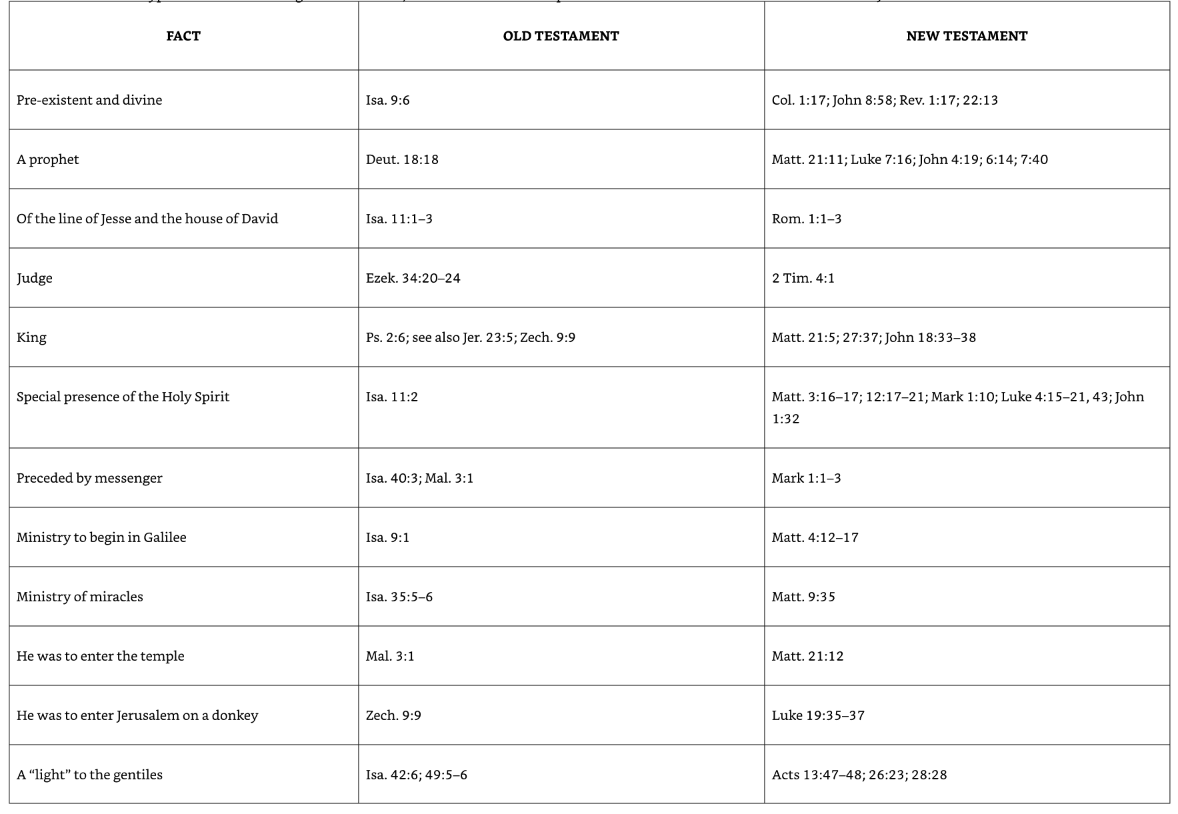
CHAPTER 19: DOES THE OLD TESTAMENT FORESHADOW JESUS? Part 2
-
THE SERVANT SONG OF ISAIAH: One of the most remarkable prophecies concerning the sufferings and mission of the Messiah is found in Isaiah 52:13–53:12, commonly referred to as one of the Servant Songs.
-
The individual in this text is identified as God’s “servant” throughout the prophecy, which indicates that he would be a prophet or religious leader. The servant’s pitiable condition is described in 52:14: “His appearance was so marred, beyond human semblance, and his form beyond that of the children of mankind.” Yet according to verse 15, he would influence many nations for good, albeit in a manner typified in the Jewish sacrificial system. Verse 15 also indicates that he would be acknowledged by gentile kings, though his identity had not been hitherto revealed to them. The text goes on to assert that the servant would be scarcely recognized for who he was (Isaiah 53:1–3). In fact, his physical appearance would be so unattractive that the people would not find him desirable (verse 2). The text indicates that he would be despised and rejected and that his life would be marked by sorrow and grief (verses 3–4). Furthermore, the servant would be accursed by God, though his suffering was for our sakes (verses 4–5). He would be pierced as well as scourged, though it was not for his own sins, but rather for those of others, which were, in consequence, atoned for (verses 5–6). His suffering would be voluntary and endured with patience (verse 7). He is even likened to a lamb being led to the slaughter, which carries echoes of Passover. He is described as remarkably silent before his accusers. He would be put on trial, unjustly condemned, sentenced to death, and executed (verse 8). He would be appointed to die with the wicked, and the rich would be involved in his burial, though he was perfectly innocent and his speech was without deceit (verse 9). God, however, would raise him from the dead (verse 10), and through his suffering and intercession many people would be made right with God (verses 11-12). It is worth appreciating the context for Isaiah 53, which names what the suffering servant will bring with him: peace, joy, salvation, and the rule of God (Isaiah 52:7-10). Echoing Isaiah 40, the text speaks of the Lord himself coming to Zion to redeem his people. The New Testament writers speak of all these blessings as coming through Christ, who is the fulfillment of these prophecies.
-
THE MESSIAH WOULD BE JEWISH: In Deuteronomy 18:18, God says to Moses, in reference to the Messiah, “I will raise up for them a prophet like you from among their brothers. And I will put my words in his mouth, and he shall speak to them all that I command him”. This indicates that the Messiah would be Jewish. God also told Abraham that through his offspring all the nations of the earth would be blessed (Genesis 22:18).
-
THE MESSIAH WOULD BE OF THE LINE OF DAVID: Various texts indicate that the Messiah would be of the line of David. For example, Isaiah 9:7 indicates that he will sit “on the throne of David and over his kingdom”. Isaiah 11:1 also describes the Messiah as being “a shoot from the stump of Jesse [the father of David]”.
-
THE MESSIAH WOULD BE BORN IN BETHLEHEM: According to Micah 5:2, the Messiah would be born in Bethlehem: “But you, O Bethlehem Ephrathah, who are too little to be among the clans of Judah, from you shall come forth for me one who is to be ruler in Israel, whose coming forth is from of old, from ancient days”.
-
THE MESSIAH WOULD HAVE GLOBAL INFLUENCE: The Scriptures indicate that though the Messiah would be rejected by his own people (Isaiah 53:3–4), he would ultimately bring representatives of all nations to a recognition of the God of Israel (Isaiah 42:6; 49:6; 52:15; Daniel 7:14). This is an improbable feat, one uniquely fulfilled by Jesus of Nazareth.
-
THE CRUCIFIXION: Psalm 22 contains a description of the sufferings of the Messiah that bears striking resemblance to a crucifixion scene. Verses 12–18 say, Many bulls encompass me; strong bulls of Bashan surround me; they open wide their mouths at me, like a ravening and roaring lion. I am poured out like water, and all my bones are out of joint; my heart is like wax; it is melted within my breast; my strength is dried up like a potsherd, and my tongue sticks to my jaws; you lay me in the dust of death. For dogs encompass me; a company of evildoers encircles me; they have pierced my hands and feet. I can count all my bones— they stare and gloat over me; they divide my garments among them, and for my clothing they cast lots. Dislocation of bones, lack of strength, dehydration, heart failure, and piercing of hands and feet are all apt descriptions of the experience of crucifixion. Part of the humiliation of crucifixion was that the victim would be stripped naked. This comports with the psalmist’s description of the dividing of his garments and the casting of lots. The psalmist also appears to portray a public execution event, since people are said to stare and gloat over him. That Psalm 22 is indeed a messianic text is supported by the fact that the deliverance from death of the individual concerned is said to be occasion for the world’s conversion (Psalms 22:27-31). Furthermore, verse 6 says, “But I am a worm and not a man, scorned by mankind and despised by the people”. This resembles the language of Isaiah 53:3; “He was despised and rejected by men, a man of sorrows and acquainted with grief; and as one from whom men hide their faces he was despised, and we esteemed him not”.
-
THE REMOVAL OF THE SCEPTER: Way back in the beginning of the Bible, in Genesis, the patriarch Jacob blessed his sons and their descendants. He told Judah, “The scepter shall not depart from Judah, nor a lawgiver from between his feet, until Shiloh comes; and to Him shall be the obedience of the people” (Genesis 49:10). The word translated “scepter” in this passage means a “tribal staff ” or “a ruler’s staff.” The “tribal staff ” of Judah was not to pass away before Shiloh came. For centuries Jewish and Christian commentators alike have taken the word Shiloh to be a name of the Messiah, for it means “peace-bringer.” The southern kingdom of Judah was deprived of its national sovereignty for the seventy-year Babylonian captivity. But Judah never lost its “tribal staff ” or “national identity” during that time. They still possessed their own lawgivers or judges even while in captivity (Ezra 1:5, 8). According to Genesis 49:10 and to the Jewish interpreters of the Old Testament, two signs were to take place at the advent of the Messiah:
- Removal of the scepter or identity of Judah
- Suppression of the judicial power After the return from Babylon, there was no king. The Maccabean princes, who ruled for a time, were of the tribe of Levi. Herod the Great, who had no Jewish blood, succeeded the Maccabean princes and was appointed as an agent of Roman rule. Though the tribe of Judah existed, it provided no kings: the Idumean line of Herod continued to rule, under the authority of Rome. The power of the Jewish lawgivers was also sharply restricted at the time of Christ, including the loss of the power to pass the death sentence, which was reserved for the Roman Empire alone. Thus, the prophecy of Jacob to Judah was fulfilled in the time of Christ.
-
THE GLORY OF THE LORD FILLING THE TEMPLE: Writing during the days of the building of the Second Temple, approximately 520 BC, Haggai prophesied in sweeping terms that the glory of the Lord would fill the temple and bring peace (Haggai 2:6–9). While the verses mention silver and gold, interpreters have noted that this Scripture must refer to more than just physical splendor, as in many ways the Second Temple was inferior to the first. The best explanation is that Jesus the Messiah, the Lord himself, who carried the very presence of God, came to this temple, worked miracles there, and taught the people God’s ways. The Prince of Peace visited the temple and, after his resurrection, sent his Spirit to his apostles, who continued working miracles at the temple. In this way, the glory of God filled the Second Temple in a way that was greater than the way he filled the First Temple.
-
DIVINE VISITATION AT THE TEMPLE BEFORE ITS DESTRUCTION: Multiple Old Testament prophecies testified that the Messiah would come while the temple at Jerusalem was still standing (Psalms118:26; Daniel 9:26; Haggai 2:7–9; Zechariah 11:13; Malachi 3:1). This is of great significance since the temple was destroyed in AD 70 and has never been rebuilt! The passage from Daniel is exact: “After the sixty-two weeks Messiah shall be cut off, but not for Himself; and the people of the prince who is to come shall destroy the city and the sanctuary” (9:26). The chronological sequence is remarkable:
- Messiah comes (assumed)
- Messiah cut off (dies)
- Destruction of city (Jerusalem) and sanctuary (the temple)
-
Titus and his army destroyed the temple and city in AD 70; therefore, either the Messiah had already come, or this prophecy was false.
CHAPTER 20: WHAT ARE THE OBJECTIONS TO MESSIANIC PROPHECY?
-
Objection #1: The gospel authors deliberately crafted their biographies of Jesus to make Jesus appear to fulfill the Old Testament Scriptures. Answer: One response to this objection is to point out the historicity of specific messianic prophecies. For instance, it is incontrovertible that Jesus uniquely brought representatives of all nations to a recognition of the God of Israel, fulfilling Isaiah 49:6. There is also good evidence Jesus was born in Bethlehem, fulfilling Micah 5:2. And there is compelling evidence of the destruction of the temple within a generation of the life and ministry of Jesus, fulfilling Daniel 9:26. These are just a few of the examples that cumulatively challenge the idea that the gospel writers made it appear as if Jesus fulfilled the Old Testament Scriptures. In many cases, we can historically establish that the prophets’ predictions came true. Additionally, there are several reasons to believe that the gospel authors reported Jesus’s life and words accurately. They wrote the truth even at risk of persecution, and they did not play to what their audience might expect. At the time the gospels were written, the Christian church was undergoing considerable persecution. Many Christians were martyred in excruciating and inhumane ways, such as by crucifixion, being burned alive, or being fed to wild animals. Since the gospel writers had nothing obvious to gain from inventing a new religion, and everything to lose, this suggests they recorded what actually happened and what Jesus really said. Although the gospel authors evidently embraced an elevated Christology (e.g., Jesus is identified as Yahweh in Mark 1:2–3), Jesus himself, in quoted speech, is remarkably cryptic about his self-identity. It seems likely that if the gospel authors had felt themselves at liberty to make things up, Jesus would have been recorded as stressing his own messianic and divine status much more emphatically.
-
Objection #2: Old Testament types and foreshadowings are typically stretched and contrived and therefore offer little evidential support for Jesus’s messianic credentials.
-
The close correspondence between details in the life of Jesus and various Old Testament texts can be explained only by either (1) purposeful contrivance or (2) divine orchestration. Because the New Testament authors wrote courageously to record real history accurately, the weight of detailed evidence leans toward divine orchestration as the best explanation.
-
Objection #3: The gospel authors took various Old Testament texts out of context to prove that Jesus was the Messiah.
-
Let us consider one common example of a passage that the New Testament is frequently alleged to quote out of context. Matthew quotes Hosea 11:1 toward the beginning of his gospel: “Out of Egypt I called My son” (Matthew 2:15). Matthew states that Jesus’s return from the flight to Egypt after the death of King Herod “was to fulfill what the Lord had spoken by the prophet”. In the original context of Hosea 11:1, the “son” called out of Egypt is in fact the nation of Israel, called out of Egyptian slavery. However, when we see what Matthew is attempting to do in quoting this text, it becomes clear that Hosea is not being quoted out of context at all. One theme of Matthew’s gospel is that Jesus is the true Israel—that is to say, Christ succeeds where Israel failed. This is seen, for instance, in Matthew 4:1–4, where Jesus is led into the wilderness for forty days and forty nights to fast and be tested. When the devil tempts Jesus to turn stones into bread, he quotes Deuteronomy 8:3: “Man shall not live by bread alone, but by every word that comes from the mouth of God.” The context of this text is Israel’s wilderness wandering for forty years, during which time the people hungered and were tested. Matthew draws a similar parallel between Jesus and Israel in Matthew 2:15, where Jesus is said to fulfill Hosea 11:1—just as Israel was called out of Egypt, so likewise is the Messiah. There is even a parallel between Herod the Great’s slaughter of the infants of Bethlehem and Pharaoh’s slaughter of the Hebrew infants in Egypt. The exodus is said to have taken place “by night” (Exodus 12:29–42). The phrase “by night” is also used in Matthew 2:14. Thus, Matthew is not interpreting Hosea 11:1 as a messianic prophecy. Rather, he is drawing a parallel between the history of Israel and the life of the Messiah.
SECTION 6: EVIDENCE FOR THE RESURRECTION OF JESUS
- Everything rests on Jesus rising from the dead. As Paul made clear in 1 Corinthians 15, if Jesus has not risen, then Christianity is false. End of story.
CHAPTER 21: ARE MIRACLES POSSIBLE?
-
If there really is a God who created the world and designed its laws, then the norm of dead people staying dead can’t restrict God from supernaturally raising his Son.” Here’s the simple point that must be repeated: If God possibly exists, then miracles are possible.
-
To reject miracle claims outright, the skeptic needs to prove that God does not exist. But the nonexistence of God has never been shown.
-
The unpredictability of miracles means we can’t test them with the scientific method. The scientific method requires a hypothesis, a controlled experiment, and a conclusion. Since God is sovereign, we cannot test his actions as we can other events in nature. But this doesn’t mean we can’t investigate the miraculous. In some cases, scientific tools may help. For instance, science could be used to verify that someone had a medical condition, such as a tumor, and then that tumor is gone. Miracles occur within history, so they can be investigated like other events in the past.
-
God can’t create square circles or married bachelors because they are logical impossibilities. But there’s nothing logically contradictory about some events that are not physically possible. For example, it’s physically impossible to walk on water. But there’s nothing logically contradictory about it, and thus God can make it happen if he desires.
-
Miracles are for more than amazement. They serve God’s purposes in two primary ways. First, they confirm a message from God. Miracles are a sign of the truthfulness of God’s word. Second, miracles confirm a messenger from God. In John 3:2, Nicodemus says of Jesus, “Rabbi, we know that you are a teacher who has come from God. For no one could perform the signs you are doing if God were not with him”. Many people followed Jesus because of the signs and wonders he performed.
-
If it’s possible that God exists, then it is certainly possible that this God may choose to intervene in the regular course of nature in a unique way. After all, if God can create the universe and all its laws, then certainly God can violate those laws if he wants. Miracles are most definitely possible.
CHAPTER 22: WHAT ARE THE FACTS OF THE RESURRECTION?
-
First, the Gospels and other New Testament documents attest that Jesus died by crucifixion (Matthew 27:35–50; Mark 15:27–37; Luke 23:33–46; John 19:23–30; Galatians 2:20). Second, science confirms that what Jesus endured during and prior to his crucifixion would certainly have killed him. In an article in the peer-reviewed Journal of the American Medical Association, William D. Edwards, Wesley J. Gabel, and Floyd E. Hosmer noted that Jesus’s death would have occurred from many factors, such as “hypovolemic shock, exhaustion asphyxia, and perhaps acute heart failure,” and possibly even “fatal cardiac arrhythmia.” To confirm whether Jesus was dead, a solder pierced Jesus’s side with a spear.
-
Jesus’ death as a consequence of crucifixion is indisputable. That he was crucified is as sure as anything historical can ever be, since both Josephus and Tacitus … agree with the Christian accounts on this basic fact. The crucifixion of Jesus by the Romans is one of the most secure facts we have about his life. Whenever anyone writes a book about the historical Jesus, it is really (really, really) important to see if what they say about his public ministry can make sense of his death. I take it absolutely for granted that Jesus was crucified under Pontius Pilate. Security about the fact of the crucifixion derives not only from the unlikelihood that Christians would have invented it but also from the existence of two early and independent non-Christian witnesses to it, a Jewish one from 93–94 C.E. and a Roman one from the 110s or 120s C.E.
-
Crucifixion was the most shameful way to die. It certainly would have been a poor way to start a new religion by inventing a claim that the founder had been stripped, tortured, and publicly dishonored.
-
In Jesus’s day, women had low social status and were not considered credible witnesses. Their testimony was not considered as valuable as a man’s testimony. If the disciples were inventing the story of the empty tomb, why include women as the first witnesses? It is deeply counterintuitive and suggests that the disciples believed women really discovered the empty tomb.
-
The empty tomb is attested by multiple New Testament sources (Matthew 28:11–15; Mark 16:1–8; Luke 24:1–12; John 20:11–18). Aside from these explicit references, speeches in Acts 13 (verse 29) and the creed in 1 Corinthians 15:3–5 presuppose that Jesus’s tomb was empty.
-
The Jewish leaders accused the disciples of stealing Jesus’s body (Matthew 28:11–15). This is significant because you don’t accuse someone of stealing something that isn’t missing.
-
In at least twelve distinct instances, Jesus appeared to individuals or groups of people after his death, burial, and resurrection:
      1. Mary Magdalene (John 20:11–18)
      2. Women leaving the tomb (Matthew 28:8–10)
      3. Emmaus disciples (Luke 24:13–35)
      4. Simon Peter (Luke 24:34; see also 1 Corinthians 15:5)
      5. Disciples without Thomas (Luke 24:36–43)
      6. Disciples with Thomas (John 20:24–29)
      7. Disciples at the Sea of Galilee (Tiberias) (John 21:1–2)
      8. Disciples on a mountain in Galilee (Matthew 28:16–17)
      9. Disciples (Luke 24:50–52)
      10. Five hundred believers (1 Corinthians 15:6)
      11. James, Jesus’s half-brother (1 Corinthians 15:7)
      12. Paul, an enemy of the church (Acts 9:3–6)
CHAPTER 23: TWO ALTERNATIVE EXPLANATIONS FOR THE RESURRECTION
-
While various theories can account for some of the facts, no known naturalistic theory can account for all the facts.
-
ALTERNATE THEORY #1: APPARENT DEATH THEORY:
-
The apparent death theory (sometimes referred to as the swoon theory) posits that Jesus did not die on the cross, but only appeared to die.
-
There are at least twelve reasons for confidence in the biblical account that Jesus died on the cross:
-
- The nature of his injuries—whipping, beating, lack of sleep, a crown of thorns, and his collapse on the way to his crucifixion while carrying the cross—were life-endangering in themselves. The nature of crucifixion virtually guarantees death from asphyxiation.
-
- The piercing of Jesus’s side, from which came “blood and water” (John 19:34), indicating serum separated from clotted blood, gives medical evidence that Jesus had already died.
-
- Jesus said he was dying while on the cross: “Father, into your hands I commit my spirit” (Luke 23:46). John writes that Jesus “gave up His spirit” (John 19:30).
-
- The Roman soldiers, who were trained executioners, were charged to make sure that he died. Even though it was customary for soldiers to speed death by breaking the legs of the victims, they did not break Jesus’s legs, for their examination determined that he was already dead (John 19:33).
-
- Before giving the body to Joseph for burial, Pilate summoned the centurion to make sure Jesus had actually died (see Mark 15:44–45).
-
- Jesus’s body was wrapped in about a hundred pounds of cloth and spices and placed in a sealed tomb until the third day (John 19:39–40). If Jesus had not died from his previous torture, he would have died in the tomb from lack of food, water, and medical treatment.
-
- It is unlikely that the disciples would invent a crucifixion story, since it was such a shameful death, if it were not true.
-
- Non-Christian historians from the first and second centuries, such as Tacitus and Josephus, recorded the death of Jesus of Nazareth.
-
- The earliest Christian writers after the time of Christ, such as Polycarp and Ignatius, verified his death by crucifixion on the cross as well.
-
- Given his traumatized physical condition, Jesus would have found it extremely difficult, if not impossible, to roll the stone back from the entrance of the tomb, especially from inside the tomb, as there would be no way to obtain leverage against the stone to roll it out of the way (Matthew 27:60).
-
- If Jesus were to succeed in rolling away the stone, he would have had to escape without alerting the guards. Whether the guards had fallen asleep, as the story goes (Matthew 28:13), or they were wide awake, Jesus would not be likely to get away from them given his poor physical condition.
-
- Even if Jesus had recovered enough to escape the tomb (and the guards!), he certainly would have been in terrible condition. If Jesus had come to the disciples in the state this theory requires, they would not have viewed him as their risen Lord or as someone who had conquered death
-
-
-
ALTERNATE THEORY #2: THEFT THEORY
-
The first form is that the disciples stole the body from the sealed and guarded tomb and then conspired to falsely teach that Jesus had been resurrected. The second form is that grave robbers stole the body.
-
Matthew was the first to record it (28:11–15): Now while they were going, behold, some of the guard came into the city and reported to the chief priests all the things that had happened. When they had assembled with the elders and consulted together, they gave a large sum of money to the soldiers, saying, “Tell them, ‘His disciples came at night and stole Him away while we slept.’ And if this comes to the governor’s ears, we will appease him and make you secure.” So they took the money and did as they were instructed; and this saying is commonly reported among the Jews until this day.
-
They spent their entire lives preaching about the resurrection, built an entire movement around it, and were willing to suffer and die for it.
-
An empty tomb alone would not have convinced Paul, persecutor of Christians, or James, the brother of Jesus, that Jesus rose from the dead.
-
It was not the empty tomb alone that convinced people that Jesus had risen but also his postresurrection appearances.
-
The disciples were scared and in hiding and would not have wanted to take on a sealed and guarded tomb since they were probably afraid of suffering the same fate Jesus had suffered: crucifixion. Remember that the disciples ran away during his arrest, as Jesus predicted (Matthew 26:31, 55–56). Even Peter, though he tried to summon up the courage to follow Jesus into the courtyard, ended up denying Jesus three times (John 13:36–38; 18:15–18, 25–27). These were not the actions of a group of followers bent on standing up to soldiers guarding a tomb. All the evidence we have indicates they were confused and afraid.
-
They immediately jumped to naturalistic conclusions, just as any modern person would. Consider various responses given to the empty tomb:
- Someone moved the body (John 20:2).
- The gardener moved the body (John 20:13–15).
- The women were accused of speaking nonsense, and the men did not believe them (Luke 24:1–11).
- The body was stolen (Matthew 28:11–15). Neither gentiles nor Jews expected a bodily resurrection of the Messiah. It was an entirely new concept. A dramatic event must have caused their new belief.
-
CHAPTER 24: THREE MORE ALTERNATIVE EXPLANATIONS FOR THE RESURRECTION
-
ALTERNATE THEORY #3: HALLUCINATION HYPOTHESIS
-
The hallucination hypothesis states that perhaps Jesus’s followers did see him after his crucifixion, but what they saw was just a vision or a hallucination.
-
There are five reasons why hallucinations are a poor explanation for the resurrection data:
-
- Many people saw Christ appear.
-
- They saw Christ individually, not together.
-
- Christ did not appear just once but several times.
-
- People did not just see him but also touched him, talked to him, and ate with him.
-
- The hallucination theory cannot explain the empty tomb.
-
-
We are not aware of any documented scientific evidence to support the idea of group hallucinations, much less that the disciples and Jesus’s other followers were hallucinating in this case.
-
-
ALTERNATE THEORY #4: WRONG TOMB THEORY
- We see five major problems with this theory:
-
- Even if the disciples went to the wrong tomb, this does not account for their belief that they had seen the risen Jesus.
-
- The Gospels state that the empty tomb convinced no one except John. Mary concluded that the gardener stole the body. The disciples did not believe upon seeing the empty tomb, but rather were confused.
-
- The wrong tomb theory cannot account for the conversion of Paul. He converted based on his belief that he had seen the risen Jesus, not on an empty tomb.
-
- An empty tomb alone would not have convinced the skeptic James. Like Paul, James saw the risen Jesus.
-
- The evidence suggests that the tomb’s location was known because a well-known man, Joseph of Arimathea, buried Jesus in his own tomb. If the burial by Joseph was an invention, then we might expect ancient critics to state that Joseph denied this version of the story.
-
- We see five major problems with this theory:
-
ALTERNATE THEORY #5: FAMILY TOMB THEORY
-
According to this view, Joseph of Arimathea’s tomb was temporary, and Jesus’s body was moved prior to the women coming to Joseph’s tomb to complete the burial process, which would explain why they discovered Jesus’s tomb empty. The theory does not tell us who moved the body for reburial.
-
An ossuary in the excavated tomb contained the inscription “Jesus, son of Joseph.” But the original archaeologists dismissed its alleged significance given the popularity of the names Jesus and Joseph in the Palestinian region during its time.
-
First, some experts say that the primary inscription does not contain the name “Jesus,” claiming it is a different name. If this is true, the whole theory collapses.
-
Given how popular the names Jesus, Mary, and Joseph were among Jews in first-century Palestine, the presence of these names in a family tomb is not surprising. Further, Matthew was not a family member of Jesus. Why would a disciple from a different family be buried in the family tomb of Jesus? Finally, since Jesus’s family had no connections to Jerusalem, he would likely have been buried in Galilee along with other family members.
-
-
While there are more naturalistic theories than we’ve considered here, they all share one common failure: an inability to account for all the known facts.
-
The debate is not largely about the historical facts but about how to interpret them. And worldview is at the heart of how people interpret the facts. If there is no God, then there must be a naturalistic explanation for the origin of the belief in the deity and resurrection of Jesus. But if we are open to the supernatural, then the resurrection becomes a much more reasonable explanation.
CHAPTER 25: WERE THE APOSTLES MARTYRED FOR BELIEF IN THE RESURRECTION?
-
Even though they were crucified, stoned, stabbed, dragged, skinned, and burned, every last apostle of Jesus proclaimed his resurrection until their dying breath, refusing to recant under pressure from the authorities.
-
Keep an important point in mind: The willingness of the apostles to suffer and die for their faith doesn’t prove the resurrection happened or that Christianity is true. It is part of a cumulative case for the resurrection that helps establish the sincerity of the apostles. It shows they weren’t liars and that they truly believed Jesus had appeared to them after his death.
-
Stephen was stoned to death after his witness before the Sanhedrin (Acts 6–8). And Herod Agrippa killed James the brother of John (Acts 12:2), which led to the departure of the rest of the Twelve from Jerusalem. The first statewide persecution of Christians was under Nero (AD 64), as reported by Tacitus and Suetonius.
-
Now let’s examine the evidence for each martyred apostle.
-
Peter:
- Another first-century reference to the martyrdom of Peter comes from Clement of Rome (1 Clement 5:1–4). Even Bart Ehrman concludes, “It is clear that Peter is being told that he will be executed (he won’t die of natural causes) and that this will be the death of a martyr.” Some second-century sources for the martyrdom of Peter include Ignatius (Letter to the Smyrnaeans 3:1–2), Apocalypse of Peter, Ascension of Isaiah, Acts of Peter, Apocryphon of James, Dionysius of Corinth (Eusebius, Ecclesiastical History 2.25.4), Muratorian Canon, and Tertullian (Scorpiace 15, Prescription against Heresies 36). The early, consistent, and unanimous testimony is that Peter died a martyr.
-
Paul:
- The traditional view is that Paul was beheaded in Rome during the reign of Nero between AD 64 and 67. Scripture does not directly state his martyrdom, but hints in both Acts and 2 Timothy 4:6–8 show Paul knew his death was pending. This and other evidence throughout Acts and the Pauline letters (especially 2 Corinthians 11) show that Paul endured many sufferings and dangers on account of the gospel. The first extrabiblical evidence is found in 1 Clement 5:5–7 (ca. AD 95–96), in which Paul is described as suffering greatly for his faith and then being “set free from this world and transported up to the holy place, having become the greatest example of endurance.” While details regarding the manner of his fate are lacking, the immediate context strongly implies that Clement was referring to the martyrdom of Paul. Other early sources for the martyrdom of Paul can be found in Ignatius (Letter to the Ephesians 12:2), Polycarp (Letter to the Philippians 9:1-2), Dionysius of Corinth (Eusebius, Ecclesiastical History 2.25.4), Irenaeus (Against Heresies 3.1.1), Acts of Paul, and Tertullian (Scorpiace 15:5-6). The early, consistent, and unanimous testimony is that Paul died a martyr.
-
James, Son of Zebedee:
- Only a few apocryphal accounts survive surrounding James, the Son of Zebedee.
- His martyrdom is first recorded in Acts 12:1–2: “About that time Herod the king laid violent hands on some who belonged to the church. He killed James the brother of John with the sword”.
- Although we have only one early source for the death of James, there is no good reason to doubt Luke’s account of his death at the hands of Herod.
-
James, Brother of Jesus:
- The earliest evidence for the death of James comes from Josephus in his Antiquities 20.197–203 (ca. AD 93/94). Unlike the Testimonium Flavianum (Antiquities of the Jews 18.3.3), this passage is largely undisputed by scholars. It places the dating of James’s execution to AD 62, since Josephus puts his death between the terms of two Roman procurators, Festus and Albinus. According to this account, the high priest Ananus had James stoned to death. Although some of the details vary, the death of James is also reported by Hegesippus (Eusebius, Ecclesiastical History 2.23.8–18), Clement of Alexandria (Hypotyposes Book 7), The First Apocalypse of James (gnostic text), and the Pseudo-Clementines (Recognitions 1:66–1.71). The case for the martyrdom of James is strengthened by the fact that there are Christian sources (Hegesippus, Clement of Alexandria), Jewish sources (Josephus), and Gnostic sources (First Apocalypse of James) that affirm its occurrence within a century and a half of the event, which suggests an early, widespread, and consistent tradition regarding the fate of James.
SECTION 7: WHY THE RESURRECTION OF JESUS MATTERS
CHAPTER 26: WAS JESUS’S RESURRECTION PHYSICAL OR SPIRITUAL?
-
The Bible contains many instances of individuals being brought back to life. For example, Elisha raised the son of the Shunammite woman (2 Kings 4:35), Peter raised Tabitha (Acts 9:36–42), and Jesus raised his friend Lazarus (John 11:43–44). How are these revivals different from Jesus’s resurrection? What sets apart Jesus’s coming back to life from all these other miraculous events of dead people being revived is that they would eventually die again—to be raised a final time with all those who belong to Christ at his second coming.
-
In addition to all this, Jesus’s resurrected body had new characteristics that his preresurrection body did not possess. He was able to appear and disappear at will (Luke 24:31, 36–37, 51; John 20:19, 26), and he ascended to heaven in his physical body (Acts 1:6–11). None of these other people who were raised had yet received their resurrected bodies; they were raised in their mortal, flesh-and-blood bodies. This is why they were revived, not resurrected, while Jesus was resurrected in the fullest sense.
-
The Bible records at least two instances where people were taken directly to God without dying. Enoch lived 365 years and then was taken away directly by God (Genesis 5:21–24). The prophet Elijah was taken to heaven by a whirlwind (2 Kings 2:1). These are not examples of resurrection because there is no evidence either man died; both were simply taken by God to heaven.
-
In 1 Corinthians 15:44, Paul says that the body that is “sown” (dead and buried) is natural, while the body that is raised is spiritual. Then, in verse 50, he says that “flesh and blood cannot inherit the kingdom of God.” Therefore, isn’t Paul arguing that the resurrection is not physical but is immaterial? Is he contradicting the gospel writers who claimed Jesus was resurrected with “flesh and bones” (Luke 24:39)? Not at all. “Natural” and “spiritual” are not opposites. In verses 42–44, Paul is contrasting our weak, perishable bodies with the strong, imperishable bodies into which we will be resurrected. By “spiritual,” Paul does not mean “immaterial,” but “Spirit-filled.” Our current bodies “run” on food and water, but our resurrection bodies will be powered by the Spirit. Paul makes a similar comparison earlier in his letter. In 1 Corinthians 2:14–15, he discusses how the natural person does not understand the things of the Spirit of God, while the spiritual person does and so is able to judge God’s teachings clearly. Here, the “natural” person is the one without the guidance of the Spirit, while the “spiritual” person is the one guided by the Spirit. With this distinction in mind, we see that Paul is not contrasting the physical with the immaterial in chapter 15. Rather he contrasts weak, earthly bodies with strong, Spirit-filled resurrection bodies. In both cases, the bodies are physical. But spiritual bodies will be filled with a power and glory, unlike our current weak, corruptible bodies, which are subject to decay. That is Paul’s point.
CHAPTER 27: DID JESUS CLAIM HE WOULD RISE FROM THE DEAD?
-
Why does it matter if Jesus claimed he would rise from the dead? Isn’t it good enough that he did? Resurrection claims are significant for several reasons. The fulfillment of these claims gives evidence that Jesus is not a false prophet. The Old Testament forewarned against unfulfilled claims from self-styled prophets: “When a prophet speaks in the name of the LORD, if the thing does not happen or come to pass, that is the thing which the LORD has not spoken; the prophet has spoken it presumptuously; you shall not be afraid of him” (Deuteronomy 18:22). So Jesus’s predictions followed by evidence that the resurrection actually occurred strengthens our confidence that he is who he claimed to be—God incarnate: Then some of the scribes and Pharisees said to him, “Teacher, we want to see a sign from you.” He answered them, “An evil and adulterous generation demands a sign, but no sign will be given to it except the sign of the prophet Jonah. For as Jonah was in the belly of the huge fish three days and three nights, so the Son of Man will be in the heart of the earth three days and three nights. The men of Nineveh will stand up at the judgment with this generation and condemn it, because they repented at Jonah’s preaching; and look—something greater than Jonah is here. The queen of the south will rise up at the judgment with this generation and condemn it, because she came from the ends of the earth to hear the wisdom of Solomon; and look—something greater than Solomon is here. (Matthew 12:38–42)
-
Jesus not only predicted his resurrection but also directed the disciples as to what they should expect and do after it happened. When the Jewish authorities demanded a sign of his authority, he responded in terms that the disciples afterward understood as a fulfillment of an Old Testament type. From that time Jesus began to show to His disciples that He must go to Jerusalem, and suffer many things from the elders and chief priests and scribes, and be killed, and be raised the third day (Matthew 16:21). As they came down from the mountain, Jesus commanded them, saying, “Tell the vision to no one until the Son of Man is risen from the dead” (Matthew 17:9). While they were staying in Galilee, Jesus said to them, “The Son of Man is about to be betrayed into the hands of men, and they will kill Him, and the third day He will be raised up.” And they were exceedingly sorrowful (Matthew 17:22–23). “Behold, we are going up to Jerusalem, and the Son of Man will be betrayed to the chief priests and to the scribes; and they will condemn Him to death, and deliver Him to the Gentiles to mock and to scourge and to crucify. And the third day He will rise again” (Matthew 20:18–19). “After I have been raised, I will go before you to Galilee” (Matthew 26:32). As they came down from the mountain, He commanded them that they should tell no one the things they had seen, till the Son of Man had risen from the dead. So they kept this word to themselves, questioning what the rising from the dead meant (Mark 9:9–10).
-
The Jews replied to Him, “What sign of authority will You show us for doing these things?” Jesus answered, “Destroy this sanctuary, and I will raise it up in three days.” Therefore the Jews said, “This sanctuary took 46 years to build, and will You raise it up in three days?” But He was speaking about the sanctuary of His body. So when He was raised from the dead, His disciples remembered that He had said this. And they believed the Scripture and the statement Jesus had made (John 2:18–22).
-
When Jesus instituted this ceremony at the famous Last Supper, he directly referenced his death through the breaking of his body (the bread) and the spilling of his blood (the wine).
CHAPTER 28: DOES THE RESURRECTION RELATE TO JESUS’S DEITY?
-
While Jesus hung on the cross, some of the chief priests and scribes mocked Jesus by saying to one another, “He saved others; Himself He cannot save” (Mark 15:31). Their taunt implicitly acknowledged that Jesus was known to have miraculously saved others from death.
-
Jesus did not use miraculous power to escape from the cross, because he came to die for our sins, as he indicates in Mark 10:45: “The Son of Man did not come to be served, but to serve, and to give His life a ransom for many.”
-
Allowing himself to be captured, tried, and executed communicates the heart of his mission: to redeem humanity and usher in the kingdom of God. The Christian belief in the death of Jesus is not a later myth that seeped into the church or an accidental fact of history. Rather, it is the culmination of the Old Testament teaching that sacrifice is necessary for forgiveness. As an act of love and redemption, Jesus chose to die.
CHAPTER 29: WHY DOES THE RESURRECTION MATTER?
- Jesus’s resurrection is not just another biblical miracle. The resurrection has a great impact on the life of the believer. It is the central miracle of the Christian faith. It guarantees our salvation (Romans 10:9), gives us strength and hope, and secures our future resurrection. The resurrection means that Jesus is alive, and he is still with us today. No matter what you’re going through, you are never alone. And if you’re a follower of Christ, the same power that raised Jesus from the dead dwells within you too (Romans 8:11).
CHAPTER 30: FINAL WORDS OF ENCOURAGEMENT
-
Questions are not only okay but a good part of the Christian life. Jesus calls us to love God with our minds and to seek answers (Mark 12:30)! One thing we have both learned is that, if we are willing to do our homework, there are good answers for the toughest challenges to the Christian faith. If you have nagging doubts, we want you to know you are not alone. Jude said to have mercy on those who doubt (verse 22).
-
Jesus promised us, “Seek, and you will find” (Matthew 7:7).