Playing With Movement
My Personal Takeaways →Playing With Movement: How to Explore the Many Dimensions of Physical Health and Performance
By Todd Hargrove
INTRODUCTION
-
Humans are not the fastest or strongest animals, but we are unmatched in our versatility. We can do back flips, run for miles at a stretch, dance ballet, lift hundreds of pounds, do cartwheels, shoot long range three pointers, climb trees and cliffs, throw curveballs, swim through oceans and lakes, and play the harmonica.
-
We are born to run, and also to walk, climb, dance and do millions of other things.
-
In fact, a sedentary lifestyle has been compared to smoking in its effects on general health. Chronic pain is the biggest source of physical disability in the world, and metabolic disorders affect almost a third of the U.S. population.
-
Although our culture continues to produce spectacular athletes, sport is becoming less of a game and more of a business. Kids get most of their movement from organized classes, not unstructured play. As a result, they are specializing in sport earlier, and burning out faster. Adults have “workout routines,” but the experience is often exactly that, work and routine. The average exercise program is not very fun or meaningful. This is part of the reason exercise feels like a chore, and why most people don’t do it with enough volume, variety, and intensity to get its beneficial effects. Everyone knows that physical activity provides the health benefits of a “miracle drug,” but few get a sufficient dose.
-
Play is a natural behavior that evolved to help animals solve complex problems in the face of uncertainty. If you want to get better at a sport, find a sustainable exercise program, or even get out of pain, you will need to play with movement. This means moving in a way that is fun, exploratory, variable, intuitive, and personally meaningful.
-
All animals develop skill, resilience, and well-rounded fitness through play, not “working out.” But the mainstream approach to training and therapy is all work no play. It is focused on movements that are boring, repetitive, planned, stressful, and done only to accomplish some external goal. This stems from a reductive mindset that views the body as a machine to be “fixed,” as opposed to an organic self-organizing system that adapts and learns.
-
You don’t need perfect knowledge to resolve complex problems, which paradoxically often have relatively simple solutions.
-
Similar principles hold for improving sport performance. Top experts in training admit it’s very hard to know how work in the gym will transfer to the field of play. The surest path to better function is relatively simple: play the game, making sure to vary its intensity, frequency, and rules.
CHAPTER 1: MOVEMENT HEALTH
-
It is more important to know what sort of person has a disease, than to know what sort of disease a person has. —HIPPOCRATES
-
Stress plus recovery equals growth. If you don’t fully recover, you can’t fully adapt.
-
The most popular forms of exercise — CrossFit, yoga, Zumba, Body Pump, and spin class — get people energized through group dynamics.
-
Green fields, hiking trails, playgrounds and dance floors all encourage us to get moving. Other environments tell us to stop moving and sit still: a town with wide streets and no sidewalks; a neighborhood without parks or green spaces; a job that requires constant typing; a living space with couches all pointed at the TV.
CHAPTER 2: PLAY
-
Play helps animals build resilient bodies, develop physical fitness, learn movement and social skills, and become more adaptable and creative in general. All intelligent animals play, and the more intelligent the animal, the more it plays. Humans are the smartest, most adaptable animals, and play the most. And they do the most playing at times of life when they need to do the most learning and developing.
-
Philosophers from Rousseau to John Dewey have argued that children learn best when their natural interests are nurtured instead of suppressed. The word kindergarten literally means “garden for children,” and reflects the idea that child development is grown not engineered.
-
Some of the all-time greats, including Wayne Gretzky, Ronaldhino, and Johan Cruyff, specifically credit play and pure love of the game as the basis for their success. They express concern that overly regimented training methods, including early sport specialization, are counterproductive.
-
The psychologist Mihaly Csikszentmihalyi coined the term “flow” to refer to deeply rewarding and meaningful experiences that occur when people are completely absorbed in an activity that requires skill and concentration to perform well. One of its qualities is the feeling that effective actions are occurring automatically, spontaneously, or effortlessly, without the need for excessive self-consciousness or willpower.
-
Exercise that is unpleasant and meaningless might burn the exact same calories as exercise that creates a state of flow. But the psychology is very different, and this has important consequences. One is the decreased likelihood of showing up to do more exercise tomorrow, next week, or next year. Research shows that people who exercise because they enjoy it, or because it gives them a personal sense of mastery, are more likely to adhere to their fitness plans than people who are motivated by “body reasons” like looking better in selfies or swimsuits. Further, adherence is higher when exercise provides an immediate sense of gratification, compared to a distant reward in the future.
-
Animals and babies generally stop playing when they are sick or stressed out. If you haven’t eaten for several days, this isn’t a good time for some major roughhousing or capture the flag. Play, almost by definition, never compromises the recovery dimension of movement health. So animals and kids have the good sense to avoid optional physical activities when they need to rest. But competitive adult humans can get carried away. They love to run, dance, or do CrossFit so much that they may continue with these activities even when they are highly stressful.
-
For example, soccer players juggle balls on their shoulders and balance them on their heads. Basketball players spin balls on their fingers, and dribble two balls at once. Golfers can strike perfect drives out of mid-air after dropping the ball from their hand. These tricks have no practical value, but the attitude which led to their discovery is part of what allowed them to master their sport.
-
Play is sometimes used as a synonym for tinkering. It means trying to resolve a problem by fiddling around with different variables in a semi-random manner. This is in contrast to a more workmanlike strategy, which relies on precise planning. Tinkering is different — you solve a problem just by messing around, and things tend to sort themselves out of their own accord.
CHAPTER 3: COMPLEXITY
-
Another challenge with complex systems is that they may have too many parts (or interactions between them) to measure. This can be a major problem if small gaps in knowledge lead to large prediction errors. This is common in stock markets, weather systems, or political elections, where there is always major uncertainty about future events. If you ask ten experts for long-term predictions in these areas, you might get ten different answers, and many would not outperform common sense or a coin flip. A similar confusion can be seen with low back pain — many of my clients have received more than five different diagnoses and prescriptions from different experts. The lesson is that with complex problems, more data does not necessarily lead to better understanding. Looking too closely at the details can cause you to miss the big picture.
-
The big picture on human bodies is that they are like ant colonies. They are made of billions of cells that pursue their own local interests, engaging in simple behaviors like taking in food, repairing damage, repelling invaders, or sending communications to other cells. They have no idea they are part of some larger plan to form an intelligent body. And yet somehow their interactions do exactly that. We are not machines but ecologies, and we operate according to similar logic.
-
Physical activity is easier if we create the conditions that make the body want to get moving, such as finding meaningful activities, favorable social and environmental contexts, or getting more sleep.
-
When we get injured, positive feedback loops quickly increase pain sensitivity: Tissue damage causes inflammation, which increases the sensitivity of nerve endings, which makes them more active, which causes more inflammation, and so forth. This is why several hours after a sprained ankle, the whole area has become massively sensitive. Eventually, negative feedback loops will restore normalcy: Inflammation initiates healing, which reduces damage, which allows more movement, which creates more healing, which reduces inflammation. What if the negative feedback loops don’t kick in properly, and the injured area remains stuck in a positive feedback loop? For example, pain prevents movement, which prevents healing, which prevents movement, which reduces fitness, which prevents movement. Playing with movement is a way to escape this loop. Introducing a new stimulus, even a random stimulus, can shake up the system, reactivating negative feedback loops that may have fallen asleep at the switch and need a wake-up call.
-
Diversity makes the system resilient, by making sure all the eggs aren’t in the same basket. In contrast, machines are not variable, and this makes them fragile. When a key part breaks, they stop working. But organic systems continue to function even after serious injury. A car missing one tire can’t move at all, but a dog with only three legs gets along pretty well.
-
Playing with movement is about escaping well-worn grooves and exploring new territory.
-
If the body’s organization depended exclusively on top-down direction from the brain, it would completely fall apart as soon as the brain’s attention shifted elsewhere. We don’t crash the car when we stop thinking about driving. Because coordination lives in interactions between many different parts of the body, it continues even when individual members are injured or distracted. Trying to impose strict top-down control over movement (e.g., by consciously bracing the core or firing the glutes) is unlikely to improve organization and may even make it worse.
-
You can’t control a body in the same way you control a machine. The former problem is properly considered “complex,” while the latter is merely “complicated.”
-
For complicated problems, expertise and planning are incredibly important. Complex problems are different, because expertise isn’t necessary or sufficient for success. The classic example is raising a toddler, which is something that complete amateurs succeed at regularly. Toddlers are self-organizing creatures, and will usually do just fine if you give them food, shelter, love and attention. On the other hand, they are also unpredictable, and therefore even an expert in child discipline might fail in getting one to behave. Further, different experts recommend completely different child-rearing strategies, which is very telling. You will not see engineers arguing over what makes planes fly, but there are radically different opinions about the best ways to raise children, stimulate economic growth, or build peaceful relations between nations. When qualified experts have major disagreements over the basics of how to solve a problem, it is most likely complex. Other examples of complex problems would be eating a nutritious diet, finding motivation to exercise, developing basic movement skills, losing weight, gaining muscle, improving sleep, and minimizing emotional stress. In most cases, expertise will probably help, but will not provide a quantum leap over common sense, individual experimentation, and a strong intention to succeed. Although complicated problems always require expert knowledge, solutions to complex problems might be deceivingly simple. You can lose weight by simply eating less and moving more. You can build strength by following any one of many resistance training programs. You can improve endurance by just going out for a comfortable run and building mileage slowly. Getting these jobs done is not necessarily easy, because you need to find the time and motivation to do them, and you need to deal with dilemmas that arise, such as aches and pains. But the basic plan is not rocket science, and you don’t need to complicate it. This is the idea underlying the KISS principle — keep it simple stupid. We tend to complicate things when we start analyzing, measuring and systematizing. According to Paul Plsek, mechanical thinking believes that “it is necessary to plan and control or there will be chaos.” This attitude can be counterproductive, because a controlling mindset may limit the freedom an organic system needs to self-organize. This has been noted by systems theorists in a wide variety of contexts, including public policy, health care, child development, and motor learning. For example, trying to control your posture by sitting up straight will probably make you less comfortable than just allowing your trunk to move naturally. An exercise or rehab program that is full of complicated rules about technique and sets and reps and times may kill the motivation to comply, which defeats what should be the primary goal. Because we cannot acquire full knowledge over complex systems, we need to remain humble in our interventions, acting more like a gardener cultivating growth, and less like a craftsman shaping an object.
-
Thinking in terms of constraints can be non-intuitive if we assume that behavior always derives from some form of command. For example, if you want your kids to engage in some productive activities, you could command them to go outside or read a book. (Good luck with that.) Or, you could use a strategy based on constraints: take away their computers, TVs and iPads, and tell them they can do whatever they want. The result might be good — they go outside, read a book, or maybe even find a better option you didn’t even think of. Self-organizing systems perform best when they are given freedom within appropriate limits, as opposed to being told exactly what to do. Many personal trainers know this intuitively, using a “constraints led approach” to teach movement.
CHAPTER 4: STRESS AND ADAPTATION
-
All exercise, even play, is essentially a form of stress, and can improve strength, endurance, mobility and overall physical function. There is almost nothing about your physical wellness that hasn’t been developed by stress, or that couldn’t be improved further by more. “Good stress” produces favorable adaptations, and usually involves some challenge that is short-lived, controllable, and maybe even fun. Examples are roller coaster rides, a quick series of sprints, rock climbing, a long walk, public speaking, or crossword puzzles.
-
“Bad stress” is usually prolonged, unpleasant, excessive, and largely beyond your control. Examples are traffic jams, insomnia, abusive relationships, and car crashes. Over time, or even in an instant if the stress is extreme, these events can overwhelm the system, or slowly deplete vital resources, leaving you weaker and less adaptable. This helps explain why exercise is generally healthy, while chronic emotional stress is not.
-
Why does chronic stress cause so many different health problems? Part of the answer is that a good stress response is fundamental to life, and therefore involves almost every major system in the body — cardiovascular, immune, nervous, endocrine, etc. Chronic stress therefore has the potential to overload the body in multiple ways.
-
Eustress (good stress) creates adaptations that make you strong and healthy, and distress (bad stress) overwhelms you, making you sick and weak.
-
Your muscles are the size they are, and not larger, because it would be costly to build and maintain a bigger set, and the body doesn’t want to pay these costs unless it’s necessary. To encourage a change, you need to send a strong message that the current state of the body is not getting the job done. The same considerations apply to building denser bones, thicker tendons, more lung capacity, and even better movement skills. Therefore, the degree of stress that will drive an adaptation must be great enough to create a minor crisis.
-
Fitness adaptations have a “use it or lose it” nature. When the stress that creates them is removed, the adaptations slowly fade. That being said, muscles seem to retain some “memory” of their prior level of strength and endurance, making it easier for them to recover their past abilities after they are lost.
-
You can predict injury in high school athletes by looking at how many hours they sleep. One study found that athletes who slept less than eight hours per night were 1.7 times more likely to get injured than athletes who slept more than eight hours.
-
One of the complexities of stress is that it depends on perception.
-
The lesson is that stress depends on subjective perception, which in turn depends on past experience, expectation, and knowledge about your skills and abilities. If you don’t perceive a challenge, there is no stress response. And if you do perceive a challenge, even if one does not exist, your body will react.
-
The magnitude of the stress response is not directly dependent on the magnitude of the stressor. Instead it is the emotional resonance attached to the stressor —the registering of the stimulus as threatening or benign; as stimulating or anxiety inducing— that ultimately dictates the extent of the stress defenses mobilized. Accordingly, the response to any given stress or is heavily modulated by subjective perception.
-
The one thing every good plan has in common is gradually progressing the level of stress, while making sure the kind of stress is varied.
-
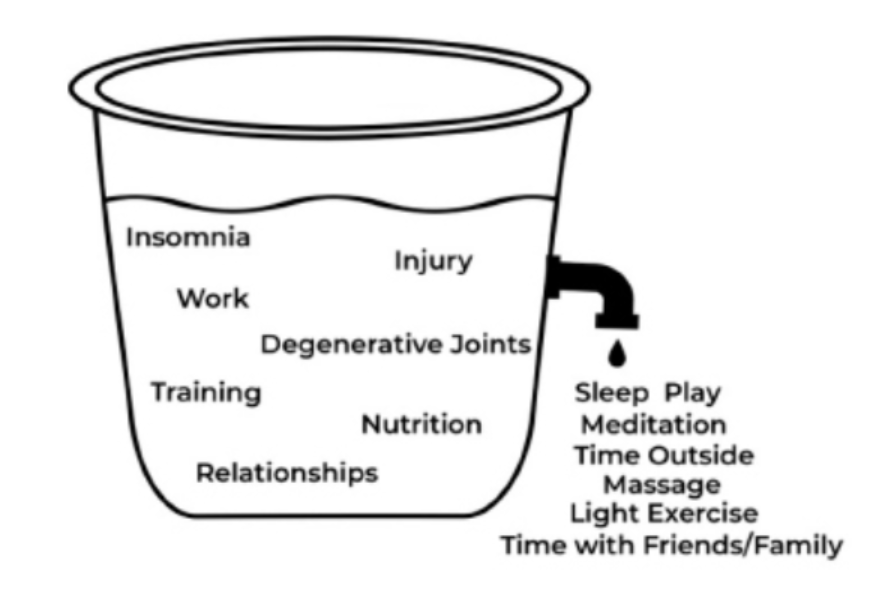
The bucket is filled with stressors, both emotional and physical. These might relate to exercise, work, travel, relationships, finances, sleep, or illness. As long as your bucket is not overflowing, you can adequately respond to each stressor, and fully recover before new ones arise. In fact, you may grow stronger as a result of challenging yourself at the right level, especially when there is adequate chance to recover, and the stresses are of the kind that we evolved to adapt to, such as physical activity. The right amounts and sources of stress can increase the size of the bucket, representing a higher level of general health, resilience and work capacity. But if the bucket overflows, you will immediately get some negative feedback — perhaps pain, fatigue, or anxiety that does not quickly subside after a reasonable recovery time. If your bucket continues to overflow, your resilience will start to suffer. The size of the bucket will effectively become smaller, meaning that you have less adaptive capacity. Over longer periods of time, chronic stress may awaken dormant vulnerabilities, both genetic or environmental, to chronic pain, fatigue, anxiety, autoimmune disease, or insomnia. In the context of exercise, excessive physical stress may cause “overtraining,” which can impair performance, decrease motivation, and elevate the risk of injury and psychological burnout.
-
When back pain suddenly shows up, we are tempted to blame it on the last minor stressor that affected it, such as a soft bed in a hotel. This is like blaming your bankruptcy on the last latte you bought before your account finally went into the red. Thinking in terms of the bucket provides a more expansive view of cause and effect.
-
The goal is to slowly grow the size of your bucket over time, so that you increase your resilience and general function.
CHAPTER 5: FITNESS
-
Asking who is “fittest” is roughly analogous to asking who is the most physically “prepared.” It begs the question: prepared for what? Cold exposure? A punch to the gut? A zombie apocalypse? Since there are many different kinds of physical stress, there are also many different kinds of fitness. Froning was perfectly fit for CrossFit competitions, as was Allen for triathlons, and Barrington for squash. None of them was even close to being optimally prepared for elite competition in the other disciplines.
-
Physical activity is now considered one of the “big four” lifestyle factors (along with smoking, nutrition and drug abuse) that have major effects on health. In 2015, the Academy of Medical Royal Colleges put out a report summarizing the benefits of exercise, calling it both a “miracle cure” and a “wonder drug.” The report observes that regular exercise can prevent dementia, type 2 diabetes, some cancers, depression, heart disease and other common serious conditions — reducing the risk of each by at least 30 percent. This is better than many drugs. The report summarizes evidence that physical activity can prevent or treat symptoms from at least twenty chronic conditions, including: Hyperlipidemia, High blood pressure, Metabolic syndrome, Diabetes, Obesity, Anxiety, Depression, Dementia/cognitive decline, Schizophrenia, Insomnia, Digestion, Parkinson’s, Multiple sclerosis, Osteoarthritis, Rheumatoid arthritis, Chronic pain, Cancer, and COPD.
-
General exercise, meaning whatever exercise you enjoy, is an effective treatment for low back pain. Most studies find that it works just as well as specific medical interventions, such as chiropractic adjustment, massage, motor control exercise prescribed by a physical therapist, core strengthening, or many forms of surgery.
-
Contrary to popular belief, running does not accelerate knee osteoarthritis through “wear and tear.” In fact, it improves function and reduces pain. Resistance training improves pain in osteoarthritis of the knee (and hip) as much as NSAIDS.
-
Physical activity reduces the risk for dementia, and improves symptoms of dementia, even one year after the exercise program ends. Aerobic exercise has been shown to improve memory, and to increase hippocampal volume. In one study, elderly adults increased gray and white matter volume after six months of aerobic exercise through walking.
-
Several randomized controlled trials have shown that moderate aerobic exercise (daily brisk walking) can cut sick days in half.
-
The effects of exercise on symptoms of depression are moderate, but probably as good as talk therapy or drug treatment. Several studies have found that exercise improves symptoms of anxiety.
-
A recent analysis of data from more than 60,000 respondents found that people exercising 1-2 times per week had a 30 percent reduction in all cause mortality compared to those who got no exercise. There was a 35 percent reduction for people who exercised 3 to 5 times.
-
Bed rest is another example of what happens to the body when it stops moving. After about a month of lying in bed, inactive muscles lose about half their strength, ligaments lose 60 percent of their ability to bear load, and tendons lose significant stiffness. If joints are immobilized in a short position for two to three weeks, adhesions may start to form that impede full range of motion.
-
Movement is like food. Nutrients in food are beneficial when consumed in some goldilocks amount — not too much and not too little. For example, you need a minimum dose of iron to avoid anemia, but too much is toxic. Many kinds of inputs to the body follow this pattern, even water. The dose makes the poison, and the cure as well. With physical activity, some minimum amount is essential, too much is toxic, and in between there is a broad range of happy mediums. Another analogy between food and movement is that you need a well-balanced diet of many different nutrients, all of which have a different optimum dose. If you have a deficiency in Vitamin A, it won’t help to double up on the Vitamin B. The same is true of physical activity. The bench press is a fine exercise, but if that’s all you ever did, you would become deficient in other areas of physical function.
-
Numerous governmental agencies, including the World Health Organization, the U.S. Department of Health Services, and the National Health Service in the U.K., have published physical activity guidelines. They are based on expert analysis of the voluminous research looking for correlations between physical activity, fitness and health. Here is a brief summary of their advice, which is almost the same for each source. The amount… The guidelines suggest at least 150 minutes per week of “moderate” physical activity, or half as much “vigorous” activity. The preferred amount of moderate activity is 300 minutes per week. Adding more exercise may continue to reduce mortality until as much as 750 minutes per week, after which point the health benefits of physical activity seem to flatline. Moderate activities are usually light aerobic exercise — continuous cyclic movements done at an easy pace. Examples include: brisk walking, hiking, gardening or yard work, jogging, cycling or swimming at an easy pace. Moderate exertion feels like you are working, but not in a way that is unpleasant or difficult to continue. Heart rate is about 60 to 80 percent of maximum, and breathing rate is elevated to a point where it would be difficult to sing, but easy to talk. You may break a light sweat but will not become significantly overheated. After finishing a session of moderate physical activity, you could probably complete another one if necessary.
-
Many common activities challenge mobility and functional movement skills, including dancing, swimming, martial arts, gymnastics, climbing, calisthenics, or classic compound strength exercises like pushups, pull-ups, rows, presses, squats and lunges. On the other hand, if all you do is bike or run, you will not be challenging your mobility or coordination very much.
-
Anthropologists who study hunter-gatherer cultures observe that they generally enjoy excellent health and fitness, and have low to non-existent rates of chronic diseases associated with a sedentary life-style.
-
Recent studies on the Hadza tribe in Tanzania show that they do about 135 minutes per day of moderate to vigorous physical activity. That’s about 900 minutes of activity a week, just a bit past the point at which recent studies have found that adding more exercise stops providing any significant additional health benefits in terms of reduced mortality. Some days involve hard work, but they are usually followed by easy days. Presumably some days will involve maximum intensity effort — sprinting, fighting, or carrying a heavy load. Interestingly, activity levels do not decline much with age. The 65 year old elders keep up just fine with the young adults. A good percentage of the total workload is walking 5 to 10 miles per day.
-
Another notable feature of walking is that it provides health benefits with only a minimal risk of injury. More intense exercise (e.g., a set of barbell squats) offers a relatively narrow window between too much and not enough. The difference between a good workout and an injury might be just a few plates on the bar. But the margin of error with walking is huge.
-
If you did nothing else but walk a lot, you’d be in better shape than most Americans.
-
With exercise, working to improve a weakness would probably have more general benefit than improving a strength. If you can already run a six-minute mile, it won’t be a life-changer to get your time down to 5:30. Also, it would be a lot of work to get there, and you would risk a repetitive stress injury along the way. But if you can’t even do a couple pushups, it would probably be pretty easy to get up to 10, and that might make a big difference in your overall functional ability. It’s a low-hanging fruit. This principle seems a bit obvious, but people ignore it frequently. In my practice, I see dancers who spend their spare time doing yoga, frail aging women who would never consider weight training, and buff football players who are only interested in their gym numbers. We have a tendency to train our strengths and ignore our weaknesses. This is understandable — part of what keeps us playing with movement is the internal reward that comes from a personal sense of mastery over physical tasks. But another aspect of play is the courage to try something new without fear of failure. A playful attitude toward movement is one that doesn’t worry too much about the embarrassments of doing something you’re not good at. If you’re willing to bear the shame of being an absolute novice for a little while, you might gain some capacities that make a real difference in your functional ability.
-
A healthy meal for one day is not a healthy meal every day. Similarly, a “meat and potatoes” exercise program (e.g., cardio, resistance training and stretching) is great. But when repeated in the exact same way for years, a change might be a good thing. This would rest areas that are repeatedly stressed, and direct work to some blind spots that are escaping challenge. Variability may also help avoid boredom. At the risk of using way too many food analogies, we should remember that variety is the “spice of life” in many areas, exercise included. Good athletic coaches make sure to vary the training stimulus. You can’t continue to make progress on the same program indefinitely. After a few months, returns will diminish, athletes will hit a plateau, and the workout will become stale and boring. Training should then be varied in some way that affords recovery from accumulated stress and stimulation of new adaptations.
-
“Vigorous” activity can provide similar benefits to “moderate” activity in only half the time. You might be able to cut your workout even shorter with extremely high intensity work, done near maximum effort. For example, a commonly studied model for high intensity interval training is the use of 4-6 half-minute max effort sprints on a stationary bicycle, followed by four-minute recovery intervals at very slow pace. These improve certain health measures (e.g., cardiovascular fitness, skeletal muscle oxidative capacity and insulin sensitivity), as much as extended aerobic training. In one study, participants completed just three reps of twenty-second max effort bicycle sprints, interspersed with two minutes of very low intensity cycling, three times per week for twelve weeks. They got similar results to another group working at moderate pace for 45 minutes per session.
-
If you want to “play” with fitness as a way to improve general health, here are some “rules of the game” to keep in mind. Have as much fun as possible within these basic constraints: •Aim for at least half an hour and up to two hours of physical activity almost every day. •Movement should be varied in terms of volume, intensity and type. Most activity can be fairly light. Walking is the most natural and beneficial movement for human beings. •Occasionally include some high intensity work that significantly challenges your strength, power, and/or capacity to sustain high energy output for a short period of time. Climbing, running and resistance training are logical choices. •Include movements that challenge coordination, balance, and range of motion. Or to put this in even simpler terms: •Move around a lot at a slow easy pace. •Frequently move with some urgency or pick up something heavy. •Every once in a while, move like your life depends on it. Here are a few notes and caveats to keep in mind. First, these recommendations apply to a broad population. Obviously, everyone is different, and people need to explore many alternatives before finding what works best for them. A skilled trainer may significantly speed up the search based on your personal needs. Second, consistency is more important than perfection. A suboptimal plan that is executed every week for years is way better than the perfect plan that is abandoned after a few weeks. Find a program that fits your schedule, abilities, social and environmental resources, and above all your personal interest and sense of meaning. Third, something is far better than nothing. Physical activity is an essential nutrient with diminishing returns. If you are getting almost none, then adding just a little may provide a major payoff. The difference between nine and ten hours a week of exercise is negligible, but the difference between zero and one is huge. Fourth, the guidelines are not specific directions. They are more like landmarks that you can use to stay oriented as you explore complex terrain.
-
The problem is that when you divide physical activity into abstract component parts, so that they can all be precisely measured and accounted for, the result may be a workout that is disconnected from a sense of fun, spontaneity, community, natural environment, or meaning. If that is the cost of a workout that delivers the right percentages of all the RDA recommended nutrients, it may not be worth it! Do something that you enjoy doing and feels meaningful, even if it doesn’t check every box in the guidelines.
CHAPTER 6: ENVIRONMENT
-
Cheetahs who live in zoos suffer from gastritis, kidney disease, high levels of stress and mortality, and low rates of mating. You don’t need to be a zoologist to see that most zoo animals just don’t look happy.
-
The modern environment for humans is a bit of a zoo as well, although far nicer in most respects, and usually with better Wi-Fi. Fortunately for us, we build our own cages, so we have a pretty good idea of how to keep them enriched. Of course, not everyone has the resources for as much enrichment as they might like. And even when we do, we don’t always make the healthiest choices about what kinds of enrichments to purchase. Most people are living in social and physical environments that don’t encourage healthy movement. For example: a small apartment filled with digital screens; a neighborhood without safe or interesting places to walk; a long commute to work by car; a job that requires heavy computer work; social relationships that are maintained by smart phone and social media. Everything about this environment is telling you to stop moving and start sitting.
-
Her home environment for biking is actually not that bad — she has places to ride and friends to ride with. But the campsite was slightly more favorable — more space, less traffic, and perhaps most significantly, the absence of electronic devices! A small change in context caused a phase shift in her behavior.
-
We tend to underestimate the effect of the environment on our behavior, perhaps because we overestimate our self-control and agency. We like to think we make choices based on internal psychological factors, such as knowledge, rationality, discipline or taste.
-
Why do people get so attached to CrossFit, Body Pump, or spin class? Part of what they like is the communal element and crowd energy.
-
You can go against the environmental grain if you are determined, but there is less friction in life when you go with it.
-
People like exercising outdoors better than indoors. It leads to higher levels of revitalization, cognitive attention, positive mood, and lower levels of anger, depression and tension. As a result, people report a greater interest in adhering to “green exercise” programs. They also spontaneously select higher work rates when outside. For example, one study showed that during self-paced walking in natural environments, individuals walked faster, but reported lower levels of perceived exertion, compared to walking on a treadmill indoors.
-
Other research shows that exposure to nature can have benefits even when you’re sitting still. Natural environments promote relaxation, stress reduction, immune system changes, better sleep, and faster healing times. For example, hospital patients with a window looking into green space healed faster and requested less pain medication that those with a view of a brick wall. Researchers have proposed that the benefits of natural exposure are not just about a good view, but smells, sounds, air quality, and the total experience of being outside. We shouldn’t get too romantic about the healing powers of nature, but science is starting to validate the idea that “forest bathing” is a good idea.
-
James Gibson coined the term “affordance” to describe features of the environment that create possibilities for useful actions. Classic examples of affordances are the handle on a tea cup, or the railing on a stairway. Each affords an easier way to perform a task. When affordances are perceived, they “invite” certain movement patterns. When we see a couch, we are invited to sit down. When kids see trees with low branches, they see the opportunity for climbing. Escalators afford the chance to ascend stairs without effort. Hiking trails invite exploration of physical space, while iPads do the same for virtual space. Thus, the presence of affordances will continually shape your movement behavior.
-
Some similar environmental strategies to encourage healthy behavior would be keeping junk food out of sight, or hiding smartphones and laptops near bed time. Home environments can also be enriched by adding things that invite more movement. I often leave soccer balls, kettlebells, or resistance bands in conspicuous areas of the house. Sometimes on purpose. I find pull-up bars especially attractive — I can’t resist a few swings or hangs when I see that one is within reach.
-
People who know how to do basic lifts like squats, deadlifts, and cleans are far more likely to look at a gym and see a playground.
-
Here are some simple suggestions about how to play with social and environmental constraints on movement health: 1. Put yourself into environments that encourage activity, especially outdoors. Enrich your indoor environment. Notice features of your surroundings that allow unique movement opportunities. 2. Develop basic literacy and appreciation for movements that can be done in any environment — walking, running, sprinting, jumping, climbing, throwing, dancing and gymnastics. You can’t spontaneously cartwheel on a free patch of grass if you don’t know how to cartwheel! 3. Explore movements that are well-suited to your current environment. If you live near a beach, learn how to swim and surf. If you live near the mountains, take up skiing and hiking. If you live near large football fields or tracks, train to improve your sprint time. If you have ready access to gyms, find out what kinds of exercises people really find meaningful or fun, and see if you can understand why. 4. Find social groups that encourage you to move, and that make you feel like a valued member of the group when you do. Avoid groups that make you feel guilty, ashamed, or incompetent.
-
- Take advantage of what the modern world has to offer. Although we are in some ways environmentally impoverished, we are in other ways amazingly enriched. With just a few internet searches, you can find instruction in martial arts, juggling, yoga, capoeira, soccer, kickball, gymnastics, javelin, and kayaking. If you want to learn a new dance step, there are hundreds of YouTube tutorials ready and waiting.
CHAPTER 7: STRUCTURE
-
Because anatomy is right there ready to be MRI’d, foam-rolled, and scalpelled, people are quick to assume it’s the key piece of the movement puzzle. This is especially true when the puzzle is pain, which is usually blamed on some form of structural damage, such as a bulging disc, torn rotator cuff, degenerative joint changes, or muscle knots. However, the correlation between tissue damage and pain is far weaker than you might imagine. Structure is overrated as a determinant of pain, and this leads to literally millions of unnecessary medical treatments. On the other hand, structure is underrated in its effects on coordination. The shape of the bones helps determine what movements are most efficient and comfortable for a particular person. Because everyone has a different skeleton, they must explore to find what works best for them.
-
Although they appear relatively static and senseless, bones, tendons and cartilage are always engaged, at the cellular level, in a dynamic process of trying to adapt to their conditions. Every day they grow slightly more or less capable of making certain movements safely. These adaptations may take months or even years to yield meaningful results, but they are ongoing. Adaptations to structure are specific. For example, if you repeatedly contact a certain part of your heel during walking, this specific area of the heel will slowly grow larger and denser. It’s a similar process to developing a callous on skin. Thus, the current structure of your body is the result of its “efforts,” over many years, to adapt to the specific forms of mechanical and energetic stresses that it has experienced over its lifetime.
-
At least nine different muscles can help flex the hip. If one is injured or fatigued, others take over. The same is true for almost any other basic movement in the body.
-
This section has a very important and optimistic message — structural damage to the body does not always cause pain, and pain is not always the result of structural damage. Confusion about these facts is the cause of a tremendous number of unnecessary and damaging medical treatments.
-
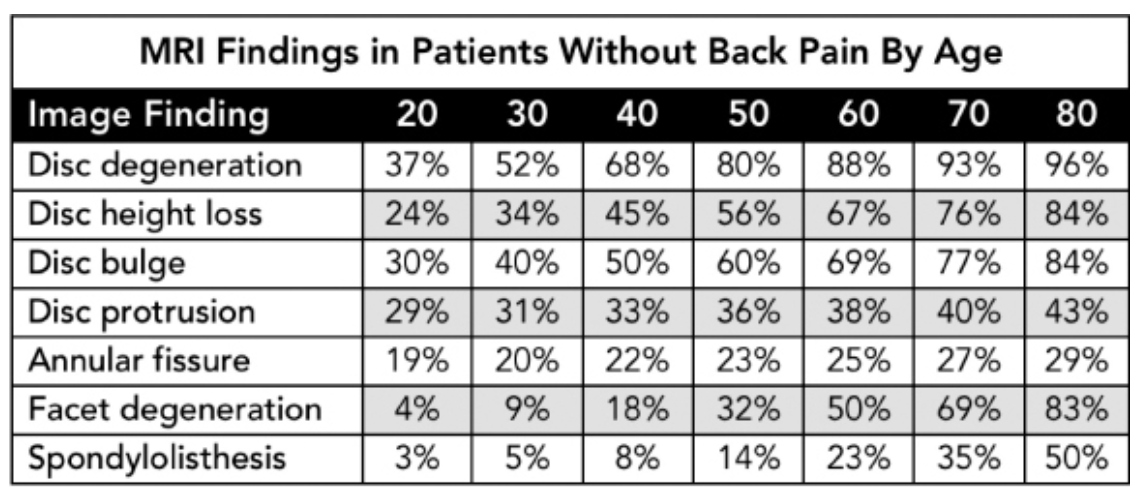
One is a series of studies showing that almost no matter where you point an MRI on a person over 30, you have a very strong chance of finding significant damage, even in places without pain. The second is research showing that many popular orthopedic surgeries to repair damage found on MRIs work no better than placebo.
-
“Our data suggest that baseline MRI findings cannot predict future low back pain.”
-
Dr. James Andrews, a nationally recognized surgeon, scanned the shoulders of 31 healthy pain-free professional baseball pitchers, finding abnormal shoulder cartilage in 90 percent, and abnormal rotator cuff tendons in 87 percent. His conclusion: “If you want an excuse to operate on a pitcher’s throwing shoulder, just get an MRI.”
-
Based on the above research, we know that tissue damage does not necessarily result in pain. That doesn’t mean it’s irrelevant. If you have a disc herniation or torn rotator cuff, pain is more likely. We can think of damage as kindling for a fire that may or may not be lit by other factors.
-
Recently, research has found that many popular surgeries (but not all) work no better than a placebo. And yet these surgeries are still done at the rate of hundreds of thousands per year. This is something you should know if you are considering surgery, or in the business of treating chronic pain.
-
Although we cannot rule out the possibility that surgery will be substantially more effective than exercise for certain patients, several studies have found that popular shoulder surgeries, such as acromioplasty, are no better than exercise.
-
I think the lesson here is that the medical establishment has some biases in the way it treats chronic pain. It favors treatments based on simple structural explanations for pain, and tends to ignore complex neurophysiological processes that may be more important. We need to be aware of these biases and learn as much as possible about the complexity of pain so that treatment can be improved. And chronic pain clients need to ask their surgeons some good questions before going under the knife.
-
Physical therapists, massage therapists, and chiropractors generally consider their view of the body to be far less reductionist than that of an orthopedic surgeon. However, many of their pain treatment methods are similarly focused on structure. Popular techniques like spinal manipulation or myofascial release are premised on the alleged ability of the therapist to make significant and meaningful changes to hard structures — bones, muscles and fascia — in just minutes, using nothing more than hands! Although these therapies can sometimes help with pain, it is unlikely that this is caused by meaningful changes to the targeted structures.
-
Indeed, research shows that the pressure required to deform mature fascia is beyond what can be applied with hands, foam rollers or even steel tools. We aren’t made of clay. If we were, our backsides would be misshapen after sitting for few minutes on a park bench. Although myofascial techniques have been shown to increase flexibility and reduce pain, the mechanism probably involves changing neurophysiological processes related to perception or coordination, not structure.
-
Some chiropractors advertise the ability to change the alignment of bones, especially the vertebrae. The claim is that they can identify joints that are “out” and then crack them back “in” with an adjustment, which is also called spinal manipulation. Although bones can certainly move at their joints, it is quite another thing for them to snap in and out of place like pieces of plastic in a children’s toy. When a joint violently pops from one place to another, as opposed to moving smoothly through a normal range of motion, this usually indicates an injury or dislocation, not a beneficial realignment. The popping sound created by a chiropractors’ adjustment is called a cavitation, and is probably caused by a small movement of the vertebrae away from each other and then back together. There is no evidence that cavitations create meaningful long-term repositioning of the vertebrae, and studies have shown that manipulation cannot change the position of the sacroiliac joint or the neck. More importantly, chiropractors are not able to predict which vertebrae will cavitate on a given manipulation.
-
Another misconception is that “muscle knots” are a common cause of pain or stiffness. To be fair, no one actually believes that muscles can literally get tied into knots. But people do think they can contract into a palpable ball, that the ball is the cause for pain, and that some kind of deep pressure is required to “get in there” and release the tension. Some classic areas where people complain of knots are the upper traps, or between the shoulder blades. There is no doubt muscles in these areas can feel tight and sore after activities where they are used for long periods of time, such as working at a computer. And pain may be related to associated muscle fatigue. But the subjective feeling of tightness is not the same as actual mechanical tightness. In fact, it is unlikely that stressed muscles become palpably tight. Studies looking for abnormal levels of EMG activity in relaxed but sore muscles are mixed, and others show that skilled massage therapists are unable to palpate a client’s back and predict which areas feel tight to the client.
-
One treatment for this condition is to surgically relocate the fibula to where the tibia should be, directly under the knee. The fibula now has to deal with the mechanical stress of bearing weight, and in just a few years this transforms the fibula into a bone that looks just like a tibia! (To see a before and after picture, do a google image search for “fibula becomes tibia.”) It’s an amazing example of adaptation and self-organization. We tend to think that bone shape is determined by genetic code, but in this case the more important constraint is environmental. Of course, these extreme adaptations are only possible when you are very young, and the body is still highly plastic.
-
Although adults cannot make major changes to the shape of their skeletons, they can make dramatic body transformations by adding muscle and/or losing fat. How much can we expect these changes to improve function? It depends on what you’re doing of course. Dropping twenty pounds of fat will certainly make you a better runner, just as adding it will improve your performance in sumo wrestling. Strength training and greater muscle mass will protect you from injury during sport and probably assist power generation in sports where power is needed, like baseball or football.
-
For the most part, the best way to develop the structural adaptations that will assist your performance in a particular activity is to … do that activity.
-
Training off the field certainly provides important benefits in terms of performance and injury protection, but is always more of a supplement than the main course.
CHAPTER 8: MOBILITY
-
How do the cheetahs train up all these different constraints on mobility to ensure optimal performance? Of course, you won’t see them doing anything that looks like a deliberate effort to stay limber, aside from a quick stretch after a nap. They certainly aren’t foam rolling or getting deep tissue massages. Their lifestyle provides all the inputs needed to ensure the system will self-organize in an adaptive way, bringing into balance a whole orchestra of different variables that create functional movement. Most modern humans follow the cheetah’s “plan” for mobility development, at least for a while. From infancy until age six or seven, a child’s mobility is shaped mostly by unstructured play, and the results seem to be pretty good.
-
As kids age, they tend to slowly lose their freedom of movement. By college, most will not be comfortable sitting for an extended time in a deep squat (assuming they can get into this position at all). Their movements up and down from the floor will probably have less variability and smoothness. By age 30, aggressive dance moves or karate kicks are inhibited by the fear of hamstring or groin injuries. At 40, some people have difficulty getting the arms fully extended overhead, especially at speed or in combination with arching and rotating the upper back. But it would be a mistake to think losing mobility is mostly about getting older (although that certainly doesn’t help!). Like many other qualities of movement health, mobility is relatively easy to preserve so long as it is used at some minimum frequency. For example, people who habitually sit in deep squats, as is common in certain Asian countries, and every hunter-gatherer culture, retain their ability to do so well into old age. I recall walking through the streets of Vietnam and seeing 80-year-old men and women eating soup or waiting for a bus while sitting on their heels. Even more impressive was their ability to move smoothly back and forth into this position from standing.
-
In Western cultures, we spend lots of time in chairs or couches, and very little on the floor. We don’t often use the end range of motion in the ankles, knees, and hips, so we lose it over time. A similar pattern occurs in the upper body, but more slowly. As we age, we reach more for the computer mouse or remote control, and less for tree branches and monkey bars.
-
Babies are born with all the mobility they need and much more to spare. The bones at their joints are well spaced, and the tissues holding them together are soft. As time goes by, they gradually get rid of the flexibility they don’t use. This is a good thing, because flexibility has a price. People with genetic connective tissue disorders such as Marfan’s syndrome or Ehlers Danlos have very flexible tissues, and this makes them hypermobile. Their elbow and knee joints hyperextend, they can bend forward to put their palms on the floor with ease, and their skin is conspicuously stretchy. This allows them to perform amazing feats on the dance floor or in the circus tent, but also increases the risk for joint damage and chronic pain. Further, hyper-mobility places more demand on coordination. When movement isn’t constrained by structure, the nervous system needs to work harder to provide control. In some extreme cases, people with hypermobile joints need to develop a high level of awareness and motor skill to avoid joint dislocations in everyday movements. Another cost of floppy joints is loss of efficiency and power. Just as a golf ball will bounce higher than a deflated tennis ball, a tight muscle or tendon has more spring. This is why elite runners have stift hamstrings and ankles, and relatively poor range of motion into a forward bend. They use their stiffness to bounce down the road. So there are tradeoffs with mobility. It’s good for some things and bad for others, and the body will tend to get rid of any movement slack it doesn’t need.
-
It is commonly believed that working to improve flexibility is a good way to prevent injury in sport. The logic is that many injuries, especially muscle pulls, occur by exceeding the safe range of motion, and therefore increasing that range might create a protective buffer zone. This is one reason athletes stretch hamstrings and adductors. However, research is mixed on whether flexibility in either muscle group is correlated with injury risk. More importantly, stretching programs have shown only limited efficacy in reducing muscle pulls. This is consistent with a large body of research on stretching in general, which has failed to produce evidence showing any benefit in reducing sport injury. What seems to work better in preventing hamstring and groin injuries is strengthening, especially eccentric exercise, which occurs when the muscle is working to prevent further lengthening. For example, the Nordic hamstring exercises, and the Copenhagen adductor exercise which both improve eccentric strength in the target muscles, are effective in reducing hamstring or groin injuries in athletes.
-
Animal studies have shown that joints immobilized into shortened positions do not lose range of motion if they are extended for as little as fifteen minutes per day. So you don’t need to worry about your joints slowly knitting themselves together if you are not constantly mobilizing and stretching. Cats sleep 20 hours, wake up, have a quick stretch, and then … move like cats. They maintain their mobility by engaging in basic functional activities at some minimum frequency. What are some basic functional activities that will maintain a healthy level of general mobility in humans? One way to answer this question is to look at the movements all healthy kids do spontaneously on a playground. Climbing, hanging, and swinging from monkey bars will challenge the shoulders to push and pull at every conceivable angle. Every joint in the lower body gets a multi-planar mobility test by moving to and from the ground in variable patterns of squats and lunges. These specific activities are not necessary to maintain mobility, but they are probably sufficient. In fact, just climbing would keep you very mobile, even if that’s all you ever did. Imagine being on a climbing structure with many potential hand and foot holds. You could very easily test every functional range of motion you have, simply by reaching for distant points in all directions with a hand or foot. Try this for ten minutes and see if anything feels left out. You don’t need a climbing wall to use this same basic template for playing with mobility. Get into any position that is functional for a wide variety of activities — standing, squatting, all fours, lunging, sitting in various positions on the floor. Now reach a hand (or foot) to a random distant point on the floor or the air, while keeping your other points of contact with the floor. (Yes, this is basically the game of Twister.)
-
We would expect that extreme ranges of motion are best achieved by moving slowly, under control, and with a relaxed mind state. In other words, something like a yoga class.
CHAPTER 9: POSTURE
-
Many common tasks require the eyes to focus in one direction for an extended period, which requires holding the same basic position. To reduce stress, posture is constantly varied in subtle ways to shift the burden from one place to another. This is why we sit in multiple positions, shift weight from one leg to the other as we stand, and generally fidget whenever we are spending more than a few minutes in the same position. Postural skills are put to a more difficult test in a dynamic context. In gymnastics, surfing, and skateboarding, just staying upright is a major challenge. In sports with an opponent, good posture affords the ability to move in any direction at any moment, which is an overwhelming advantage.
-
Further, the best posture for one person is not necessarily the best for another, because everyone has a different structure. In fact, the best posture for you in sitting at this moment is likely different from the best posture for you in a couple minutes, because by then you will be a different person, with different levels of muscle fatigue in certain areas, different functional goals, and different levels of accumulated stress in your joints. Fortunately, the postural system is highly sensitive and responsive, so it will know that you need a change, and will cause you to fidget to a slightly different position that is more comfortable and functional.
-
If we don’t become aware of postural defects and make appropriate corrections, we are likely to develop back pain, “text neck,” shallow breathing, and many other ailments.
-
The overwhelming majority of the research on posture and pain does not support a causal relationship.
-
Other relevant studies examine the effects of jobs that involve repetitive use of postures thought to be awkward or stressful. These have found that: •Sitting at work is not associated with low back pain. •A systematic review of 35 studies found that occupations that require lifting weights probably do not cause low back pain. •A systematic review of 99 studies found no good evidence of a causal connection between back pain and occupations that involve awkward postures, lifting, bending and twisting. •Although occupations that routinely require heavy lifting are associated with increased risk for back pain, the effect size is modest. The above research indicates that if any correlation exists between posture and pain, it is weak. These results are striking given that many studies have easily found other factors that correlate with low back pain, such as exercise, job satisfaction, educational level, stress, and smoking.
-
These studies may be surprising, but less so if we remember that people are living things, not machines. Unlike car tires, humans adapt to the stress of uneven alignment. Whatever posture you habitually use is probably one that you have been using for many years, maybe even most of your life. So you have already done a multi-year, everyday workout to get ready for whatever stresses your posture is currently causing.
-
Body parts are not interchangeable legos or Ikea furniture pieces made by factory molds. Wonkiness and asymmetry are part of the plan. If you aren’t convinced, play with the phone app that lets you see your face as two symmetrical right halves, or two left halves. For most people, the two faces look distinctly different.
-
While extreme deviations from symmetry are often a sign of a problem, this is not necessarily the case. Do a Google search to see pictures of the very crooked spine of Lamar Gant, an elite powerlifter. If he listened to postural experts about the dangers of loading a bent spine, he would have never managed to break world records in the deadlift.
-
Although core exercises can reduce low back pain, they seem to work no better than many other treatments, including brisk walking, general exercise, or even exercises directed towards relaxing the core muscles, which is basically the opposite of bracing. It turns out that people with back pain actually use more core activation during common movements. They brace their core muscles, so their movements into bending or twisting are “stiffer, slower, less variable and more guarded.” Bracing seems to be an instinctive response to pain, an apparent decision by the postural system to limit movements that may be aggravating a tender area. This is probably a good short-term strategy, but it may have costs over the long term. Bracing is energetically inefficient because it requires extra muscle work, and it limits mobility and function in certain contexts. And bracing works by compressing the joints, which may over time be a source of excess stress. Peter O’Sullivan, a physical therapist and back pain researcher, argues that common advice to brace your core during everyday activities may be counterproductive. He often gets clients to feel better by doing less, not more work, with their abs.
-
Good posture is complex, individual, dynamic and contextual. It doesn’t make sense to measure it with a plumb line, or try to improve it with one-size fits all rules. A better approach is to explore different postural options and find what works best for you. For example, I have noticed that standing in the same place for long periods of time, as you might do at a cocktail party or museum, will sometimes make my lower back stiff. It feels better almost immediately when I sit for a few minutes. In a slumped position! I have clients that have literally the exact opposite set of preferences, which is why they use a standing desk at work. Fortunately, most of us are attracted to good postural solutions through sensory feedback, and find them without any conscious effort. But this natural learning process can be inhibited by conscious applications of “rules” about which postures are right and wrong. Thus, instructions to brace yourself or stand up straight can be counterproductive, impairing the relaxation, spontaneity and variability that are required for efficient body use. Research shows that fear of movement related to bending or twisting can predict excessive core bracing, reduced postural variability, and bad outcomes in chronic pain. Here’s some wise words from the ecologist C.S. Holling: “Placing a system in a straitjacket of constancy can cause fragility to evolve.” The problem with common postural advice is that it encourages people to put themselves into straitjackets of constancy, causing them to be more fragile and less resilient.
-
Therefore, movements that require good integration of the trunk with the limbs, such as crawling, walking, running and swimming (all locomotive movements) will also tend to improve the organization of the trunk. Postural skill is also about balance, and therefore we might expect it to be improved through activities that challenge balance, like gymnastics, dance or skateboarding. Variability is a key aspect of coordination. Practices like yoga, Pilates, or tai chi develop skills in maintaining a particular alignment under variable conditions. In my previous book A Guide to Better Movement, I offer about twenty lessons based on the Feldenkrais Method, which are designed to help you “remember” all sorts of subtle movements in the spine and ribs that you may be neglecting. This can help you explore a broader range of options for staying upright. Strength and endurance might limit postural options in contexts where fitness is an issue. It is a challenge to hold a safe and functional posture when lifting a heavy weight, running a distance at a brisk pace, or performing a powerful throw. You need strength to resist the forces pulling you out of alignment. But fitness is less likely to affect posture during everyday activities, which require surprisingly little core strength.
CHAPTER 10: SKILL
-
Arthur Lydiard, one of the most famous running coaches of all time, summarized his thoughts about running technique with the following: “Forget about form.”
-
In the context of sport, complex actions are best exemplified by skillful control of a ball or racquet. Elite performance in these areas does not come as “naturally” as movements controlled by the lower levels. Instead, you need to put in thousands of hours of deliberate practice, and probably get some coaching as well. You also need to watch other great players and emulate what they do, because the optimal solutions to the relevant motor problems are not easy to find. You won’t just stumble over them with random explorations of the movement landscape, unless you are a prodigy.
-
Even less intuitive is turning a bicycle to the right. What do you do with the handle bars? A turn to the right is initiated by turning the handle bars slightly to the left. This allows you to lean the bike to the right, which is actually what gets you changing direction to the right. Would kids learn to bike faster if they were told that opposite-side-leaning is the trick to controlling a bike? This information would probably just be confusing. In most cases, the best teacher is the activity itself.
-
For example, one study shows that novices learn faster if they make more mistakes, which are “grist for the learning mill.” To summarize this complicated information, let’s return to a simple rule: the game is the teacher. To make sure your learning is multi-dimensional and comprehensive, remember to occasionally change the rules of the game. You don’t want to change the rules so much you are playing a completely different sport, but enough so you are challenging your abilities in slightly different ways, encouraging new adaptations, and finding robust solutions.
-
Here’s a reason this matters. Because perception and action work together, you can’t effectively practice a movement skill unless you simultaneously practice the related perceptual skills. For example, you wouldn’t train to catch fly balls by practicing running one day, and then stationary visual ball tracking the next. But similar mistakes occur in athletic training. A good example is the use of agility drills, where the athlete runs around cones in rehearsed patterns. In sport, agility is about changing running direction in response to some visual cue, such as the movement of an opponent, or the ball. When you run around cones in choreographed patterns, the perceptual challenge is removed. The resulting practice might be effective in developing a specific kind of fitness in the lower body, but it will not build links between perception and action that are critical for real-life agility.
-
Based on these considerations, coaches influenced by systems thinking try to make sure practice sessions keep perception and action “coupled.” In other words, practice should look more like a game, and less like a repetitive drill. For example, in soccer, small-sided games (e.g., four on four), are preferred to choreographed passing drills.
-
Gabriel Wulf is a leading authority on the effect of attention on performance and learning. She studies the difference between two basic types of focus: internal and external. Internal attention is directed at the body, such as the wrist action during a throw, or the extension of the hips during a jump. External attention is directed outside the body, such as a target for throwing, or an overhead object to reach for during a jump. Wulf’s research shows that in a wide variety of circumstances, external attention is superior for performance and learning. For example, one study found that unskilled sprinters ran faster when they focused on pushing their feet into the ground, compared to extending the leg behind them. External cues have also been found to improve performance in jumping, agility, and strength. They are associated with increased movement efficiency and running economy, and reduced heart rate, muscle activation, and perceived exertion. For example, runners feel like they aren’t working as hard when they focus on distance, as opposed to gait mechanics. External cues have also been shown to improve dart throwing, golf shot accuracy, balance, and posture. In each task, it seems better to focus on the end result of the task, and not the specific body mechanics used to achieve it.
-
In other words, trying to control your movement top-down interferes with bottom-up processes that are far more intelligent.
-
Research confirms that internal attention is associated with choking, even in experts. Excessive self-consciousness tends to cause paralysis by analysis and freezing of degrees of freedom. Nick Winkleman has pointed out that an expert choking moves like a novice learning.
-
When the pressure is on, getting into a flow state is not easy, but the pathways for access are built during non-stressful play. Here’s an important caveat: this doesn’t mean we should never have internal attention during performance or practice. Internal attention may be occasionally useful with novices, and in learning complex movements with many different parts. You can be sure that most pro golfers are well aware of exactly what their body is doing at many points during a swing. But during performance, and a good deal of their most useful practice, they focus on goals not methods.
-
Based on this view, physical therapists such as Greg Lehman recommend that people spend less time worrying about subtle biomechanical flaws, and more time working to improve the general health and function of the relevant joint. This relatively simple strategy is sometimes referred to as “just load it.”
-
Heel-striking is not associated with increased injury rate, and is the most energy efficient way for most people to run. This is why the vast majority of runners, including close to 75 percent of elite half-marathon runners, are heel-strikers. Further, trying to correct running form is unlikely to prevent injury, and will often cause runners to be slower and less efficient.
-
Despite these weaknesses, it would be wrong to conclude that corrective methods have nothing useful to offer. Although recommendations about how to move the “right” way are usually not mandatory, they may point the way towards unexplored options. For example, squatting with the spine in a perfect neutral position is not necessary (or even possible), but it’s an interesting challenge that may improve body awareness and functional variability in squatting. Running on your forefoot is not something you must do, but it’s a reasonable thing to try if you are having problems with your current technique. Similarly, there is no reason to fear bending at the low back when you go to pick up a sock. But if bending hurts, you should be curious about whether improved hip flexibility might help. If that doesn’t work, move on to something else. If you have shoulder pain with reaching, exercises to improve control of the scapula are a logical treatment option. But it is only one choice among many. Thus, we can look to corrective exercise for ideas on how to play with movement skill, remembering that the goal should be to expand our repertoire of movement solutions, not reduce them. We should think in terms of options not corrections.
CHAPTER 11: PAIN
-
There is no single “pain center” in the brain, and no simple switch that can be thrown to stop it. Most pains arise in the following manner: A body part is damaged, the damage is detected by sensory receptors near the site of the injury, and a danger signal is sent to the brain. The brain reads the signal, perceives the need for a protective response, and reacts in a way that creates pain. Therefore, we can think of pain as the output of a highly sophisticated alarm system. Despite the complexity of the physiological events that lead to pain, not all pains present a mystery. Pain in your foot is easily explained if you find a splinter right where it hurts. You know why your knee hurts today if you fell on it yesterday. Even when the cause for pain is not obvious, it might be discovered through a detailed medical examination, or an x-ray, which might find a broken bone or torn ligament. Thus, not all pains are complex, and a reductionist “biomedical” treatment approach works very well in many cases, especially those involving a specific pathology. But the origin of some pains is more elusive. Think of all the times you have been unable to explain why some particular pain comes or goes.
-
On average, back pain becomes more prevalent until age 60 and then declines. What this all means is that pain often cannot be blamed on local tissue damage. Instead, it may be caused by something more complex — an interplay between a variety of factors, many of which relate to the pain alarm system itself.
-
The purpose of pain is protection: if you sprain your ankle while running, pain gets you to stop running and start limping, so the ankle can rest and heal. Like the stress response described in chapter four, pain is about helping the body respond to a perceived emergency. Indeed, some experts view pain as one component of the stress response. The protective function of pain is clarified by imagining life without pain. Some people are born with congenital analgesia, meaning they can’t feel any pain at all. At first glance this sounds like a good problem to have, but the costs far outweigh the benefits. People with congenital analgesia bite through their tongues while eating, get third degree burns without noticing, and don’t realize their leg is broken until it collapses under their weight. They don’t fidget when they sit or stand, because they never feel uncomfortable. As a result, their joints accumulate repetitive stress, and they eventually develop severe degenerative joint disease at young ages. Tragically, they often die young. These facts make clear that pain is fundamental to health, function and survival.
-
Sensory receptors called nociceptors are located at nerve endings all over the body. They detect potential threats, and can be triggered by mechanical force, temperature change, and chemical conditions related to inflammation, injury, or excess muscle work. When the nociceptors are triggered, they send a signal that may or may not reach the brain, prompting it to consider whether pain is necessary to protect the area. Nociceptors have a firing threshold — a light touch to your arm will not activate them, but a firm smack will.
-
Nociceptive signals can also arise from the middle of a nerve trunk, as opposed to its ending. This is called ectopic nociception, because it arises in the “wrong place.” This confuses the higher levels of the nervous system, because they don’t know where the signal originated. Therefore, if a nerve is irritated near its root, you might feel it closer to the nerve’s ending. This is one of many reasons why knowing where it hurts doesn’t necessarily tell you where the problem is.
-
In each case, the brain wants to encourage the activity that is creating the nociception, and therefore blocks the danger signals. This is accomplished by what pain educator David Butler calls the “the drug cabinet in the brain” — cannabinoid and opioid substances that descend the spinal cord and block the upward flow of nociception. These drugs are powerful enough to provide full pain relief from catastrophic injuries, which many people won’t feel at all during an emergency. Triathletes are known to have especially powerful pain inhibitory systems. This allows them to somehow endure and even enjoy events that normal people would consider the worst form of punishment. They have excellent internal drug cabinets.
-
The eyes are a good source of information about threat to the body, and seeing is believing. When you watch a horror movie, your body reacts, even though you aren’t the one getting stabbed. There is an interesting documented case of a construction worker visiting the emergency room in terrific foot pain after a nail went through his work boot. After removing the boot, it was confirmed that the nail had actually gone between his toes. The connection between pain and visual input has been confirmed in controlled studies as well. For example, a red rod applied to the skin feels more painfully hot than a blue one of the same temperature. Needle injections hurt more if you look at the needle compared to the arm.
-
The sense of touch (mechanoreception) also has significant effects on pain, and usually serves to reduce it. This is why so many different touch therapies are effective short-term pain treatments, including massage, ultrasound, kinesiotape, foam rolling, or just good old-fashioned rubbing an owie. The mechanism is basically distraction – non-threatening sensory input gets the attention of the nervous system, especially if it is novel or interesting, and this diverts attention from nociception, making it more likely to be ignored.
-
Chronic pain is correlated with persistent negative mood, and depression seems to predict the development of chronic pain. Further, when people are induced to have negative moods in the lab, chronic low back pain increases, and pain tolerance to a new stimulus decreases.
-
The way you think about your pain can change it. If you believe it is caused by a dangerous condition, such as cancer, it may hurt worse than if you believe it is part of a natural healing process. Expectation has a particularly strong effect.
-
The classic example is placebo, which is nothing more than the pain-killing effect of expecting benefit from an inert treatment. One of the physiological mechanisms that causes the placebo effect is descending inhibition of nociception, discussed in the previous section. Another is reduction of anxiety, which tends to increase pain. Placebo’s evil twin is nocebo, which occurs when expecting pain acts as a self-fulfilling prophecy. Catastrophizing (which means expecting worst-case outcomes) is a risk factor for transitioning from acute to chronic pain. But optimism and self-efficacy — the beliefs that your pain can improve and that you are the one who can improve it — are predictors of recovery.
-
The processes in the brain that create pain are largely unconscious and therefore hard to control. We can hope to affect them through attention, education, mindfulness, and other cognitive behavioral methods.
-
Pain, anxiety, depression and stress-sensitivity may be specific manifestations of a general pattern of defensiveness and hyper-vigilance. There are few specific treatments for these conditions that work significantly better than general health interventions like exercise, sleep, and stress reduction. For example, aerobic exercise is an effective treatment for depression, and may work as well as drugs or therapy. For chronic low back pain, the most effective treatments are exercise, cognitive behavioral therapy, and education about pain.
-
Recovery is about executing the relatively simple (but not necessarily easy) strategy discussed in chapters four and five — expose yourself to a healthy level of physical stress, reduce mental and emotional stress, and maximize recovery time. In short, do everything you can to let your body know it’s strong, safe, resilient, and capable.
-
The most effective treatment for Achilles tendinopathy (and many other tendon conditions) is resistance exercise that stresses the tendon at an appropriate level, so that it can adapt and get better at withstanding load. However, it is still unknown whether the treatment works by changing the structure of the tendon, the nervous system’s sensitivity to load in the tendon, or both. Fortunately, we don’t always need to know the specific mechanism to get a good result. It is often sufficient to remember the basic principles of stress and adaptation discussed in chapter four: the body adapts favorably to stress in the right kind and amount. Thus, a relatively simple strategy of “just load it” is often an effective way to treat pain in a local area when pain is related to movement. If you challenge a tendon to do what it was meant to do at the right level of intensity, it will tend to get healthier, more functional, and perhaps less painful as well. The function of a tendon is relatively simple — handling tensional loads. Therefore, any exercise that applies a tensional load to a tendon is a potential treatment option.
-
You can also improve general health by getting adequate amounts of sleep, eating a healthy diet, avoiding excessive drug use or smoking, minimizing emotional stress, working to develop a positive attitude, and engaging in meaningful activities at home, work, and with friends. None of these interventions are likely to “fix” a specific problem in the body, but they are all capable of helping the body evolve into a healthier state.
-
Complex problems, including those related to pain, are not necessarily hard problems to solve. Recall the classic example of a complex problem discussed in chapter four — raising a toddler. Toddlers are self-organizing, and therefore gravitate toward healthy behaviors as long as you provide them with good common-sense parenting. Complex pains are similar, often resolving on their own after a few weeks of common-sense self-care. However, some complex problems are extremely difficult to resolve. Systems thinkers call these “wicked problems.” Examples include poverty, political gridlock, the opioid crisis, a broken health care system, or a failing marriage. The system is behaving badly, and the bad behavior is reinforced by feedback loops that make it highly stable. Because the problem is multi-factorial, it is not clear where you should intervene in the system. Further, many interventions, especially those directed at “fixing” a single factor, can have unintended consequences, activating feedback loops that actually make the problem worse. Unfortunately, some persistent pains are properly classified as wicked problems. We said before that physical activity tends to help with pain. What if physical activity makes pain worse? Sleep and a positive attitude are also helpful, but what if the pain is making them impossible? There are certainly no easy answers to these questions. The challenge of persistent pain has been noted by many experts. Herta Flor, a neuroscientist, compares persistent pain to a memory that is hard to forget.
-
The healing stimulus might be anything — a good massage, a weekend vacation, some yoga, a trip to the gym, or lots of walking. The efficacy of these treatments is less about specifics, and more about just perturbing the system in some way, getting it to reset to a more adaptive state. It’s like turning a computer on and off to fix a problem. But what if continued efforts to reset the system fail, and pain persists? That would suggest the new attractor well is relatively deep, or that pain has become a habit. This presents a greater challenge — old habits die hard. The good news is that habits can in fact die. Drug addictions may persist for many decades, but they can be overcome. Long-standing political conflicts can be resolved. Trauma can heal, and people who have suffered from chronic pain for many years can recover. I know this from personal experience and from talking with many others. Wicked problems can be solved. But they are not fixed with a single intervention. Positive change is slower, more organic, a process of evolution.
-
Perhaps science will someday find a simple fix for wicked pain. Until then, make sure to keep playing with movement.
Actionable Takeaways:
- Top Tips: Have as much fun as possible within these basic constraints: •Aim for at least half an hour and up to two hours of physical activity almost every day. •Movement should be varied in terms of volume, intensity and type. Most activity can be fairly light. Walking is the most natural and beneficial movement for human beings. •Occasionally include some high intensity work that significantly challenges your strength, power, and/or capacity to sustain high energy output for a short period of time. Climbing, running and resistance training are logical choices. •Include movements that challenge coordination, balance, and range of motion. Or to put this in even simpler terms: •Move around a lot at a slow easy pace. •Frequently move with some urgency or pick up something heavy. •Every once in a while, move like your life depends on it.
Numbered list of actionable takeaways.
- List out all the forms of play that are intrinsically motivating to you and that you can get absorbed in.
- Experiment with new activities and explore new territories if you find yourself in a rut.
- Exercise outdoors rather than indoors. It leads to higher levels of revitalization, cognitive attention, positive mood, and lower levels of anger, depression and tension.
- Enrich your environment. Leave soccer balls, kettlebells, resistance bands, pull-up bars etc in conspicuous areas of your house.
- Find social groups that encourage you to move, and that make you feel like a valued member of the group when you do.
- •Sit comfortably on the ground for extended periods of time in many different positions, including cross-legged, with extended legs, kneeling, or in a deep squat; •Move to and from the ground in various squat and lunges patterns, with the feet in a variety of positions, including close together, far apart, staggered, on the toes, or flat-footed; •Lift a foot to waist level at various angles to step onto an elevated surface or to deliver a kick
- Spend more time off the couch and on the floor.
- In order to prevent injuries, spend less time stretching and more time strengthening.
- Stop worrying about all of the subtle biomechanical flaws and “just load it.”
- Think positive when it comes to pain. If you believe it is caused by a dangerous condition, such as cancer, it may hurt worse than if you believe it is part of a natural healing process. Optimism and self-efficacy — the beliefs that your pain can improve and that you are the one who can improve it — are predictors of recovery.
- If you have chronic lower back pain, the most effective treatments are exercise, cognitive behavioral therapy, and education about pain.
- Expose yourself to a healthy level of physical stress, reduce mental and emotional stress, and maximize recovery time. In short, do everything you can to let your body know it’s strong, safe, resilient, and capable.
- You can also improve general health by getting adequate amounts of sleep, eating a healthy diet, avoiding excessive drug use or smoking, minimizing emotional stress, working to develop a positive attitude, and engaging in meaningful activities at home, work, and with friends. None of these interventions are likely to “fix” a specific problem in the body, but they are all capable of helping the body evolve into a healthier state.
- If you are experiencing chronic pain, the healing stimulus might be anything — a good massage, a weekend vacation, some yoga, a trip to the gym, or lots of walking. The efficacy of these treatments is less about specifics, and more about just perturbing the system in some way, getting it to reset to a more adaptive state. It’s like turning a computer on and off to fix a problem.